Fun With Numbers: Short-Term Versus Long-Term MAL Rankings

Continuing on from my previous post on the notable changes of series popularity over time, I did some similar work on rankings. The shows analyzed are the same (all those tracked in fantasy anime league from Spring and Fall of 2012 and 2013), only this time I’m looking at the evolution of rankings; how series swap places in the rankings over time and which ones rise and fall most significantly. The data used this time around can be found here.

Continue reading

Fun With Numbers: Short-Term Versus Long-Term MAL Popularity

Back in late April, I was taking a look at some available numbers which may indicated casual interest in a show, including myanimelist statistics, for the disk sales and print bumps of series aired in the latter half of 2013. In order to get the mal values, I pulled them from the site a couple of days before I posted the relevant articles. One of the comments on this article raised a very legitimate question; how did I know that these values were consistent with the ones a series had in midseason, around the time we would hope to use them to predict print boosts and disk sales before they happened. That was a key assumption – that series’ relative popularity and ratings would remain constant after the end of the season. This turns out to be a bit of an oversimplification, especially for older seasons of anime where things have had more time to change.

Using fantasy anime league data, I was able to go back and look at both the popularity and ratings a show had at the end of a season (i.e. prior to the beginning of the next season). Many seasons of data are available, but I have chosen to focus on 4: Fall 2013, Spring 2013, Fall 2012, and Spring 2012. Note that Summer/Winter seasons are not tracked by fal. This post focuses on my analysis of the evolution of the popularity numbers (collected here) as compared with values taken in late July, 2014. Namely, I want to know if series exhibit significant postseason changes relative to their peers and, if so, which series do so most prominently. I’m still playing with ratings data, and will address those in a separate post later.

Note that Kyoukai no Kanata and Kill La Kill were excluded from the Fall 2013 fal season for understandable competitive balance reasons. Their exclusion is nonetheless somewhat frustrating, as they would have been interesting to look at through this context.

Continue reading

Fun With Numbers: The Non-Cancellation of Popular Manga Post-Anime

One of the most fundamental issues I take with English-language discussion of anime is the degree to which many people simply ignore manga outright. From a demographic perspective, this makes sense; Japan spends roughly 5 billion dollars on manga every year, and in France, the annual income in dollars of the manga industry (~125 million) exceeds the number of people living in the country (~66 million), but the average United States citizen spends about 38 cents per year (120 million per year market, 318 million people) on manga while pirating or illegally streaming approximately 6 gazillion episodes of anime. Ok, I made that last figure up, but I did plug in the 2 sites that “free streaming anime episodes” pulled up for me on google into a web value calculator, and those sites, gogoanime and kissanime, have a combined estimated pageview total of 1.5 billion per year, and they’re hardly the only ones out there that do what they do.*

It’s worth noting that I’m not at all unbiased about this; manga is kind my favorite thing. And that’s why I fall into the devil’s advocate role when people try to build anime-centric narratives surrounding manga. One of the most common permutations of this phenomenon pops up when a manga series ends soon after an anime adaptation of it. I’ve seen it argued in different places that poor anime performances killed off C3-bu, Daily Lives of High School Boys, and Binbougami ga. The most oft-cited piece of evidence in these cases is the timing of the ending of the series; if the franchise became more popular, it wouldn’t make sense to end it in the middle of that boom. The issue with that line of reasoning, though, is that authors can and have quit on extremely popular series at multiple times in the past. Inoue Takehiko ended 100,000,000+ seller Slam Dunk in the middle of a major tournament, and Hiroyuki Takei ended Shaman King early for health reasons. At the very least, author burnout is an alternate hypothesis that needs to be addressed, either with additional evidence for the “cancelled” argument or a direct quote from the author. Since the latter is only available on a case-by-case basis, I’ll be taking a look at the first question; does a lack of a visible sales boost increase the odds that a manga will end a year or so after the anime adaptation?

Continue reading

Fun With Numbers: Various US Anime Movie Disk Sales Totals

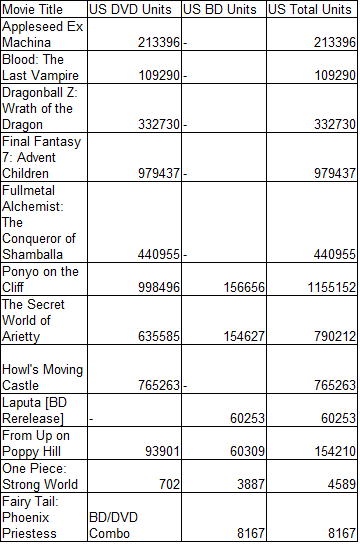
I recently made a trial account on opusdata to see what I could scrounge up as far as anime data goes. Unfortunately, I wasn’t able to get a ton of data, since the backlog of weekly charts are anything but free. But I did come away with their sales figures for a couple different anime movies, whose sales ranged from over a million to a couple thousand depending on how mainstream the title was:

anime_movies-us_salesThe One Piece/Fairy Tail movie numbers may or may not be reflective of what the shows regularly put up. I have a couple volumes’ worth of data for each, and plan on estimating what their long-term sales are after I get additional confirmation of the amazon model I’m currently using. It does seem, based on a cursory glance at the current rankings of March/April releases, like US releases have fairly long tails.

Fun With Numbers: Various Case Studies of Oricon Manga Charts Versus Copies in Print

Oricon manga reports tend to fall well, well short of the “actual” values reported by publishers. I’ve written before about one of the most extreme cases (Yuruyuri’s one million copies with 0 weeks in the charts), but there are plenty of others out there. This isn’t a comprehensive look at it (and these series may or may not represent “average” cases of underreporting); it’s just me picking a couple confirmations and counting up the total (i.e. total on weekly charts from last week a volume appeared) Oricon reported sales up to the point when the publisher reported a given number.

Some of these may simply be unsold copies, another part may represent copies sold at a 10k/week rate in the long-tail shadow of the charts, and a few may come from the overseas sales Oricon chooses not to count. How to separate those three is anybody’s guess. I’m not trying to do that, just give some idea of how big these gaps can be.

Continue reading

Fun With Numbers: First-Week Sales Rough Guesses for June 2014 R1 Releases

Since February, I’ve made it a habit to track R1 anime releases on US Amazon, hoping to get an idea of how sales figures look for specific US series. I recently finished up taking data for the month of June (available here).

Recently, that study seems to have begun bearing fruit. Combined with assumptions about the positions of their blu-ray top 20 versus the overall top 20, I was able to come up with a power law approximating how much a day ranking on US Amazon was worth in terms of disks sold per day (#=300,000/rank). Recently, I got my first substantial bit of proof that this prediction method was at least somewhat viable (to within +/-20%), and I’m at the point where I’m ready to put out very basic estimates of what first-week sales figures for various releases should look like for those series released in June.

Continue reading

Fun With Numbers: Print Boosts’ Effect on Sequel Odds

It’s been well-established that an anime adaptation of a manga or light novel can be a huge boon to the source material. What’s a bit less obvious is whether or not boosting print material can fuel the production of a second season of said anime.There are at least a few reasons why it shouldn’t; for a manga get adaptation boosts primarily from the first season – afterwards, their sales tend to plateau or drop off (even if the series does get a second season). It makes sense on an intuitive level that there would be some sort of diminishing returns on subsequent seasons of anime; sequels tend to sell between 0% and 50% fewer disks, and people don’t tend to start watching anime from the second season onward. But whether or not those diminishing returns carry over to print sales, and if so to what extent, is a somewhat separate question.

In this post, I’ll be exploring that question, comparing the rate of shows getting sequels with and without print sales boosts over different ranges of disk sales, to get an idea of whether or not print sales boosts actually “matter” towards a show’s sequel odds.*

Continue reading

Fun With Numbers: Two-Week Revisions of the 2011-2012 Manga Adaptation Data

This post took long enough to put together as it is, so I’m dispensing with the intro.

2011 data

2012 data

Read this for why I redid the existing 2011 and 2012 plots. New plots are after the jump, but first, a quick summary of the major changes:

-Whether or not Zetman and Thermae Romae got significant boosts is more dubious.

-On the other hand, Maken-ki, Deadman Wonderland, Hyougemono, Brave 10, Joshiraku, Sankarea, Acchi Kocchi, Squid Girl, and Yuruyuri all look like more probable boost recipients than before.

Continue reading

Fun With Numbers: Shogakukan’s Non-Homegrown Power Pair

One of the biggest differences between manga and western comics is the format in which it runs. While both are eventually released as collected volumes, most western comics will be first distributed in single-chapter releases, whereas manga will be first distributed in various magazines together a number of different series. The magazine model works out nicely for publishers – people pick up a magazine to read a series they’re massively into, and all of a sudden tens to hundreds of thousands of people have a chance to get a look at whatever new artist you’ve just debuted. Occasionally, that young artist ends up becoming a smash hit themselves, and you’ve got more people reading your magazine and more chances to develop more hits (while at the same time hopefully being nice to the rest of your authors).

In order for this model to work, though, you need to have people buy your magazine, and in order to buy your magazine, you need a hit series. This was a problem for manga industry mainstay and Weekly Shonen Sunday publisher Shogakukan. In 2010, they were shut out of Oricon’s top 10 manga series, and had only one series (Detective Conan, 3 times) even make the top 50 volumes that same year.

Flash forward to 2013, and they had 2 of the top 6, Magi and Silver Spoon. It’s a really impressive turnaround, even given that simple top-whatever lists fail to capture the beautiful breadth of the manga industry. How it happened is worth taking a look at, not in the least because parts of how it happened are fairly intriguing in and of themselves.

Continue reading

Fun With Numbers: Anime as Light Novel Advertisments in 2010

2010 was a year with fairly thin pickings in terms of light novel/novel adaptations. I counted less than 15 new series with books as a source, and 4 of them (Tatami Galaxy, Katanagatari, MM, and Shiki) were done before the adaptation came out, limiting our ability to measure their impact. Thankfully, there was only one series that ran through the anime and didn’t chart; Asobi ni Ikuyo. There’s a wealth of data for the other 9, though.

In any event, the pre/post-anime two-week sales totals of the light novels for which they’re available are recorded here and plotted below.

Note that, for Shinrei Tantei Yakumo, I was tracking the editions of the volumes reissued under Kadokawa; it was originally published by Nihon Bungeisha in the early 2000s, and later had one new volume (9) released before the reissuing finished. It’s irregular for a lot of reasons. Continue reading