Saturday’s here, with three shows on my preseason top 10 and another I was at least watching for the historical context. Given that, I feel like the day could have been better than it was, but since I’ll be taking the good stuff and dropping the bad anyway, I’m just happy it had some keepers.
Fun With Numbers: Shogakukan’s Non-Homegrown Power Pair
One of the biggest differences between manga and western comics is the format in which it runs. While both are eventually released as collected volumes, most western comics will be first distributed in single-chapter releases, whereas manga will be first distributed in various magazines together a number of different series. The magazine model works out nicely for publishers – people pick up a magazine to read a series they’re massively into, and all of a sudden tens to hundreds of thousands of people have a chance to get a look at whatever new artist you’ve just debuted. Occasionally, that young artist ends up becoming a smash hit themselves, and you’ve got more people reading your magazine and more chances to develop more hits (while at the same time hopefully being nice to the rest of your authors).
In order for this model to work, though, you need to have people buy your magazine, and in order to buy your magazine, you need a hit series. This was a problem for manga industry mainstay and Weekly Shonen Sunday publisher Shogakukan. In 2010, they were shut out of Oricon’s top 10 manga series, and had only one series (Detective Conan, 3 times) even make the top 50 volumes that same year.
Flash forward to 2013, and they had 2 of the top 6, Magi and Silver Spoon. It’s a really impressive turnaround, even given that simple top-whatever lists fail to capture the beautiful breadth of the manga industry. How it happened is worth taking a look at, not in the least because parts of how it happened are fairly intriguing in and of themselves.
Sell Me in 20 Minutes: Glasslip, Argevollen, and Locodol
Probably just finished one of the worst weeks of the year. It was hell on earth at work, plus the way Shueisha handles releases, splitting up the “official” release date with the one that oricon actually counts, has added probably 2 hours to the 8-hour task of redoing all 2011/2012 manga boost data. And a side-project I’m working on after finally getting tired of not actually writing about manga took up most of my time since finally getting off yesterday.
But Summer’s finally here, which is cool. Just finished getting caught up with all the material I plan on watching. Out of the four shows I’ve seen so far, Free s2 was predictably solid (though the comedy feels a little more raunchy than s1), one was bland as could be, two others were interesting enough to keep up with.
Unstoppable Hype Machine Summer 2014 #1 – Glasslip

Glass-working, rural Japan, clairvoyance, teen drama, and more all come together in P.A. Works newest anime Glasslip, and it got the Machine’s number 1 spot!
Unstoppable Hype Machine Summer 2014 #2 – Nobunaga Concerto

The Hype Machine may not be a time machine, but that doesn’t mean it can’t enjoy some good alternate history with Nobunaga Concerto!
Unstoppable Hype Machine Summer 2014 #3 – Gekkan Shoujo Nozaki-kun

Just because you can write a romance doesn’t mean you can live one, and the Machine is there to see that constant play out with Gekkan Shoujo Nozaki-kun!
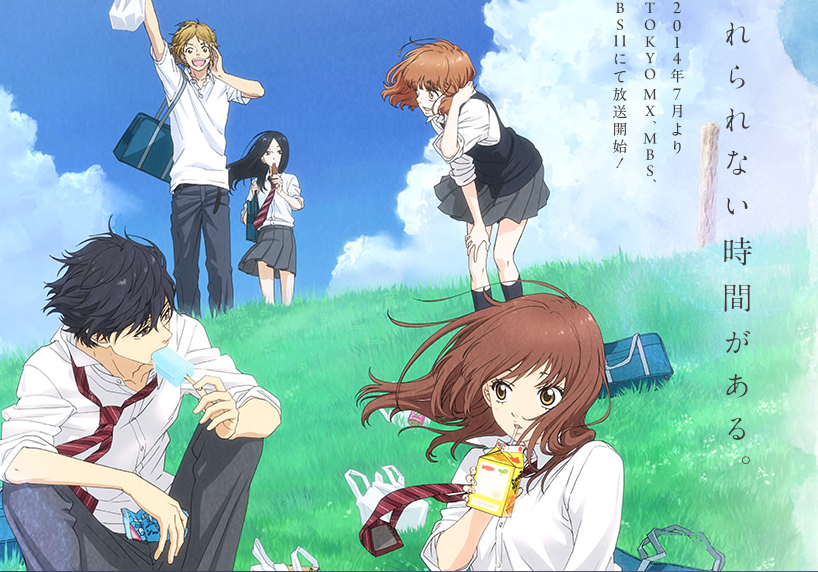
Unstoppable Hype Machine Summer 2014 #4 – Ao Haru Ride
Love is in the air with Ao Haru Ride, the Machine’s next subject!
Drew’s Note: I may have accidentally referred to Ai Yoshimura as a he, and I apologize for that misstep. She is a fine director.
Unstoppable Hype Machine Summer 2014 #5 – Aldnoah Zero

The second collaboration (per se) between Gen Urobochi and Ei Aoki is about to air. This and mecha in general are discussed by the Machine today!
Unstoppable Hype Machine Summer 2014 #6 – Hanayamata

Traditional Japanese dance is our next subject of talk with Hanayamata! The Machine dissects it now!
Via Anime Insider: ADV’s Gantz Release (April 2005)
A short article detailing ADV’s Gantz anime release plans for 13 DVDs with 2 episodes each (they later shortened it to 10 disks).