Fun With Numbers: September 2015 US Amazon Data (Initial Numbers)

This September is a month with 5 Tuesdays, and it’s a crowded month anyway, so it’s packed to the gills. Noteworthy for the usual “high initial ranks mean it just might make the charts” reasons are Space Dandy part 2, Vampire Hunter D: Bloodlust, and the 3-edition release of Tokyo Ghoul.

Also, there’s some weirdness happening this month:

-Descendants of Darkness isn’t ranking yet, for whatever reason. Hopefully whatever issue is causing that will clear up before its release date is really close.

-There are two Jojo editions, both getting preorders, both DVD-only, same MSRP, identical except for the level of detail on the amazon page and the level of discount offered. For now, I’ll refer to them on the tracking spreadsheet by their amazon url codes (B00X5UIUEU and B00XYHOIIQ).
Continue reading

Fun With Numbers: Long-Tail Figures and Uncharted Territory

Recently, via the creation of a second OpusData trial account, I was able to acquire some new data that sheds light on how several newer US anime release performed in the long term. This includes 5 releases (Attack on Titan: Part 2, One Piece Film Z, The Wind Rises, Evangelion: Ha, The Tale of Princess Kaguya) for which we have at least one week of sales data already, plus 4 releases (Momo, Hal, Bayonetta, The Cat Returns) that came out in the 12 months and failed to chart once. Excluding Evangelion: Ha, and The Cat Returns, all of these titles came out between September and November 2014, so they’re roughly comparable in terms of the amount of time since release they’ve had to accrue new sales.

[Note: OpusData and TheNumbers, where I usually get what hard US video sales data I post, are owned and operated by the same company, Nash Info Services.]

The info that can be gleaned from them is interesting, but let me just say right now that I’m really happy about the clerical error that logged Attack on Titan’s second set as a movie, and hence trackable long-term in the Opus database.

Continue reading

Fun With Numbers: Pays to Shop Around

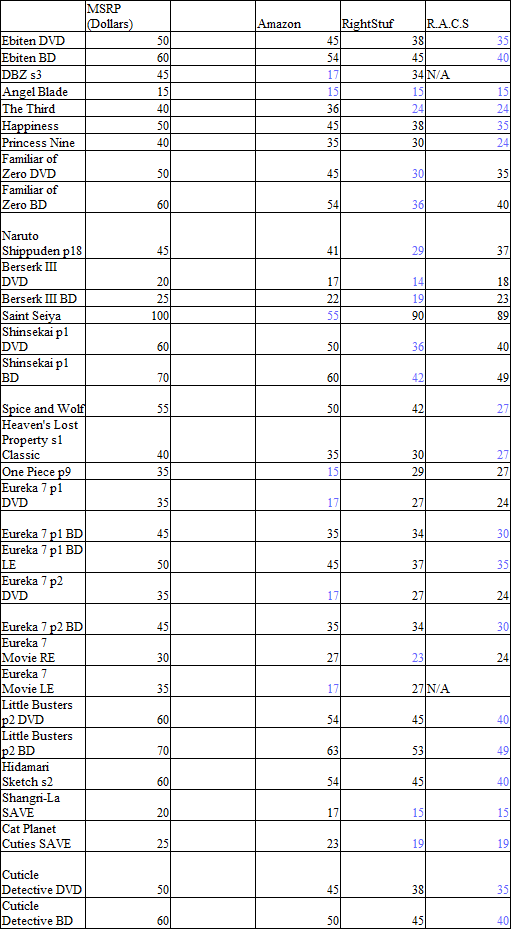
In my post-March piece on US amazon rankings, I noted there were other retailers that sold anime over the internet. I figured it was an important enough point that I took a look at the prices offered for the releases I’m tracking in April. Specifically, I took the MSRP for each of these 32 releases, and compared it to the actual prices offered at Amazon, Right Stuf, and Robert’s Anime Corner Store. Even a look limited to these three stores shows a pretty significant variation in which one offers the lowest price and how much (prices are in dollars and rounded up, lowest price in blue):

April-pricesNo one store has the consistent lowest price title sowed up. RACS seems to have be the bargain more of the time, and the amazon releases that are lower than the competition are much lower, but the relative price being offered really seems to depend on each release. Beyond helping me tweak my model and expectations for what US amazon can and can not be used for,* this list makes the millionth version of this point; if you’re going to shop for R1 releases, shop around.

*The rankings could still potentially be very indicative of the relative strength of similarly priced series, as stuff like shipping and service can cause people to prefer certain retailers. It comes down to whether amazon popularity is indicative of popularity elsewhere or not. Either way, it’s probably smart to expect Sentai releases with their lowest prices offered elsewhere to be underestimated by an amazon-only model.

Fun With Numbers: Potential Narratives from February US Amazon Data

The month of February is over, and that means I’m done with something I started back in December – an experiment tracking the amazon rankings of several R1 February releases. It should be noted that the original sample these ideas are drawn from is a very tiny one (11 total releases), so using the word “conclusions” to refer to any of this would be serious hyperbole. But there are a number of interesting threads that popped out of the data, that will hopefully inform my observations in the coming months and be either validated or falsified by a larger sample of data for March.

Continue reading