Active Engagement Through Timed Comments: Ping Pong The Animation

Anime, unlike a game, a sport, or mechanical tinkering, is a fairly passive hobby. You plop yourself in front of a screen, press play, and maybe livetweet about the episode as it’s going on. But most people watch shows straight through. Outside of refreshing crunchyroll streams frozen for too long to plausibly be a dramatic pause, an average anime requires very little user input to run from start to finish (even books and manga at least require readers to turn pages). That doesn’t mean anime is a shallow hobby, or a passive one, but it does mean that the big moments in anime, the ones that suck the viewers into the screen like some elastic pink thing, are pretty important, since viewers typically aren’t doing anything that would serve to distract them from how tacked-together and plodding a subpar sequence is. A good anime will have a few moments capable of forcing viewers to snap to full attention, and a great one will have several per episode.

These moments are often obvious to whoever experiences them, but because so much subjective and personal experience goes into how one person experiences a work of entertainment, it can be difficult to isolate these on a macro/crowd level. If attainable, that information would be useful in a number of discussions, notably in those trying to tie a particular sequence into discussions of how much it might have meant for the show sales-wise.* Participating in discussion of an episode is a way to suss out your thoughts on a show, but a lot of that discussion is per-mediated in the sense that you’ve had time to digest before you speak your piece on it. By contrast, commenting systems built into video streaming platforms offer a fast-reaction look at how specific moments or intervals in a show evoked strong, immediate reactions. Which, in turn, makes these moments likely candidates for ones that pushed people over the top from being interested to being locked-in.

Over the next couple of weeks, I’ll be taking a look at the timed comment data for several successful shows to get an idea of which moments may have been “high-leverage” ones that brought more fans into the show’s big tent. First up, the eleven episodes of Masaki Yuasa’s Ping Pong The Animation. Full disclosure: I’m writing this having seen the show, and assuming you’ve seen it too. Since this is essentially a list of scenes of importance from a slightly atypical perspective, there’s obvious spoiler potential below.

Continue reading

Fun With Numbers: One Piece Film Z Sold 6,199 Copies on Week 1

Another datapoint from the late September-early October rush of titles with early ranks made the charts. This time, it’s One Piece Film Z, a release split between DVD and BD/DVD combo pack sales that totaled a little over 6000 between them in their opening sales week. You can check the full list here while it’s up (screenshot after the jump).

Continue reading

Fun With Numbers: Scrolling Comments As a Function of Time

If you’ve immersed yourself in the culture surrounding anime more than a little, you’re probably aware that Japanese video sharing sites operate their comment sections a little differently from the way Crunchyroll does. For the uninitiated, while sites like Youtube stick their comments underneath the video for viewers to scroll down and see if they want to, sites like Nico Nico Douga have user-submitted comments scrolling across the same screen playing the video. I personally prefer this style of commentary for a variety of reasons,* and I sometimes miss the feature when transitioning to official releases. Just recently, I realized fully functional logs of these comment tracks are actually available for download at himawari douga, a fairly large** and in-no-way-legal video streaming site.

These himado comment tracks have a particularly neat (if totally necessary) feature – each comment keeps its 1/100th of a second timestamp, which usually corresponds fairly precisely with the thing in the video being commented on.*** Thus, these tracks, properly analyzed, have the potential to provide an interesting window into which moments in an episode most engage the audience. I built a very basic code**** to analyze the data, and I came up with some fun plots.

Continue reading

Fun With Numbers: November 2014 US Amazon Data (Initial Numbers)

I took these data yesterday, so the rank data tracking for November releases starts on October 27. I’m kinda down and swamped at work right now, so this is just going to be a post without much comment. If any of them looks like a possible to chart, or actually does, then I’ll be talking about them again.

P.S. Sherlock Hound/CCS got their releases pushed back a week and require an extra month of tracking as a result. I hate that.

Continue reading

Fun With Numbers: The Long and Short of 2013

“How many pages long is the average light novel?”

A friend of mine flat-out stumped me with this question a few days ago, and I’m willing to bet even odds it stumped you too. Neat, right? People familiar with anime likely have at least some vague inkling about what light novels are. But anime-focused writers who offer sweeping takes on light novels often don’t have the answers to those sorts of basic trivia questions, and I’ve forced a few acquaintances to google over this in the past week.

Granted, this particular question is sort of misleading; wordcounts are more accurate quantifiers of length than pagecounts, since the latter depend on size and typeface. Still, it underscores how little people can know about something which plays such a big role in the anime industry. Too, the question is also ridiculously basic to answer; I only had to spend about an hour on amazon compiling a list of links to the first volumes of novels adapted into anime in 2013 (excluding sequels), and taking down their given pagecounts. And while I was at it, I did the same for manga. The data, source links included, can be found here, and is summarized below. Note that Uchouten Kazoku, a single-volume novel, was counted as a novel along with the other multi-volume series.

Continue reading

Fun With Numbers: Attack on Titan Part 2 Sold 10,677 Copies on Week 1

Didn’t even take 12 hours. As expected, Attack on Titan’s second set ranked on the US charts, selling a little over a thousand fewer copies in the first week than set 1 did, but still putting up solid numbers.

USBD_09_28_2014

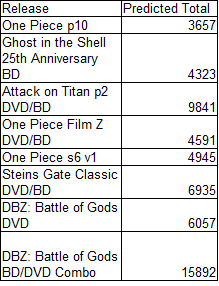
This time, my guess (9841 copies) was only off by 8 percent. That qualifies as a pretty successful test. If the S=(6944*(R^-0.4))-60 formula can ballpark the rest of this list successfully (at least, for the ones that chart), I think we may have a keeper.

Fun With Numbers: Updated US Amazon Formulae

Since late February of this year, I’ve been tracking the daily ranks of various anime releases on US Amazon to see if they could be used to get an idea of how releases were selling in the US, since that data is sparsely available for modern titles (especially unpopular ones). In March, I made my first stab at a formula which might tie thos edaily ranks to sales totals. In May, I realized that first model was based primarily on Holiday season sales charts and thus severely overestimated the market, and introduced a simpler one making use of more data. That model seemed for a time like it would be serviceable, pegging the sales of DBZ’s season 3 BDs to within 20%, but then it overestimated Attack on Titan part 1 by a factor of 3. Since I had no other test cases for my model available for the next few months, I was able to put off refining that model, but with data for the second part of Attack on Titan, the surprisingly successful Steins Gate rerelease, and DBZ Battle of Gods set to come out over the next few weeks, it’s a good time to use the data I’ve gathered to try and test a different model.

Continue reading

Fun With Numbers: Industry Valuation of In-Betweening vs. Voice Acting

Note 1: Corrected to account for more typical anime framerates (8-12 fps), rather than 24 fps.

If you’re going to be making a piece of animation, you’re obviously going to need some animators to draw some things. But anime budgets are tight, and the production costs in the industry are such that animation might not always be the best way for directors to maximize the bang they get for their buck. Anime salary data is pretty sparse, but I found enough information on certain costs to do a quick, naive calculation comparing the relative worth of in-between animation and voice acting.

Continue reading

Regarding Anime Insider Issue 50

I’m not scanning Anime Insider Issue 50 (the Nov 2007 issue). The reason for this is that someone has already done so for the entirety of the magazine, which would make redoing specific pages in black and white pretty redundant:

http://imgur.com/a/T8LW8
http://www.mediafire.com/download/n0iokyk4s9lkjh0/Anime+Insider+issue+50+2007-11.zip

[Thanks to fredofirish for the tip.]

In lieu of scanning the articles, I will note that there are several interviews in there which you may find interesting to look at:

-Mitsuo Fukuda on Gundam Seed Destiny (p. 24)

-A piece on Kaze no Stigma with comments from director Junichi Sakata (p. 34)

-A 3-page interview with Black Lagoon director Sunao Katabuchi (p.40)

-An interview with US VA/ADR Director Mary Elizabeth McGlynn (p.76)

-An interview with US VA Travis Willingham (p.77)

-An interview with US Publisher Vertical’s executive VP, Ioannis Mentzas (p. 84)