Fun With Numbers: Amazon Rank Progression for US Releases (March 11)

Now that a week has elapsed since the 9 releases from 5 March 11 titles (Accel World, Digimon, Ikkitousen s4, Psycho-Pass, Sakurasou) have been released, it’s time to dump the data plots of their daily performance.

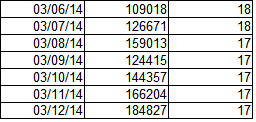
As before, here’s the rankings up to this week in Aria the Natural part 2, featuring one total copy sold and the majority of days spent ranked 120,000th or higher:

Aria-wk2

Chart is date, rank, # in stock

1 sale per day does seem to boost a series up into the 70,000th-90,000th range, perhaps for a relatively brief period. It would be kind of nice if I were able to code and could track these hourly, but that’s way beyond my ability level. At any rate, the observation made last week that 120,000th or worse means zero sales seems to hold up.

Plots (and some commentary) are posted after the jump.

Continue reading

Fun With Numbers: Blood-C and Malleable Movie Price Points

First of all, let me open this article with a mea culpa; back when I posted a quick reaction piece to the announcement that Tamako market would be resolving its romance arc vis-a-vis a movie, I mentioned that the late-night anime series with the next-lowest sales average to get an anime announced later was Bodacious Space Pirates at 7337. This was incorrect; Blood-C put up a 1577 average, though its movie, The Last Dark, was announced before the TV series even aired (meaning sales couldn’t have been a part of the decision-making process at that point).

This also represents an opportunity to spot-check one of the key assertions I made in that post – that it would be possible for Tamako Market to tap a larger, less-enthusiastic fanbase that might be more willing to spend 80,000 yen than they were to spend 300,000 yen. When anime is freely available via TV and streaming, it’s easy for people to finish shows, but not 100% of the people who finish a show want to buy it. And setting price points isn’t about making sure 100% of those people buy it, but about balancing the income per sale with total number of sales for maximum profit. However, that does mean that when an installment of a franchise comes out costing significantly less money, more people can often be expected to buy it. The K-on movie sold about 3.5 times as much disks as season 2 averaged.

It turns out this principle can apply to the lower end of the cost spectrum as well. In addition to raking in just over 67 million yen at the box office, Blood-C sold 4521+1362= 5883 total disks, also a little over 3.5 times the series’ average. With DVD and BD MSRPs at 7000 yen and 9000 yen, that means it brought in roughly 4521*4500+1362*3500=25,000,000 yen, after retailer take. Depending on the movie budget, that might have been enough money to make the movie project pretty close to break-even.

Movies of a franchise don’t always sell more than the TV series. Star Driver went from a TV series that sold 9000 disks per volume to a movie that sold about 6500 disks of the movie and made only slightly more than Blood-C (~80 million yen) at the box office. Bodacious Space Pirates’ recent movie failed to make the box office top 10. I’m not trying to say that every series has hidden riches waiting to be unearthed at lower price tiers associated with movies and OVAs. That demand curve is going to look different for every series. Bodacious Space Pirates is an instructive example of a series whose fanbase is almost entirely made up of disk buyers, as the TV anime may well have averaged more than the light novels typically do in their release weeks; volume 10’s July 11 release failed to chart in a week where the threshold was 6260 copies.

Recognizing when a series’ demand curve favors more-affordable shorter-form content is a tricky task that industry people spend a lot of time working on. I certainly don’t pretend to understand the mechanics of how every individual fanbase operates. I just think it’s important to point out that there are some demand curves which favor movie (and OVA) production for anime which are unsuccessful as TV shows, and some that don’t.

Fun With Numbers: The Late-80s OVA Boom (and Why Late Night TV Replaced It)

The two most influential series in the history of anime are almost indisputably Neon Genesis Evangelion and Mobile Suit Gundam, a pair of robot shows which showcased the buying power of Japanese otaku and led to an explosion of new material being produced. I’ve written previously about the late-night boom fueled by Eva’s success, but to say Gundam deserves less credit is to ignore one of the bestdramatized underdog stories in anime history. Then-16-year-veteran Yoshiyuki Tomino straight-up flipped a series meant to sell toys to kids for a realistic science-fiction epic in an era where the main thing robots did on TV was wrestle with one another for the spectacle. The results of Gundam’s eventual success were many; it spawned one of anime’s longest-lived franchises and has accounted for tens of billions yen in model sales per year to this day. But it had another key effect on the industry – it got people thinking about how to harness the fans with a serious sci-fi bent that Gundam had shown to be there for the taking.

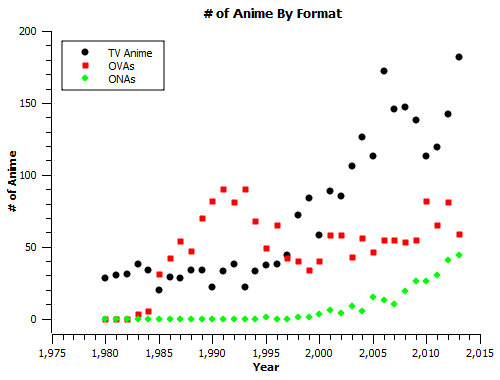
Towards the end of 1983, one year after the final installment of the Gundam movie trilogy was released, the recently-formed Studio Pierrot released the first episode of what is considered to be the first OVA series ever, Mamoru Oshii’s Dallos. The series enjoyed healthy success, and several other companies began commissioning OVA projects. What followed was a surge in the amount of new original and manga-spinoff adaptation projects marketed chiefly towards older audiences, both hentai* and not (per myanimelist, charted here). The yearly abundance of non-hentai OVAs is plotted below, along with the number of TV anime and ONAs (included mainly as a curiousity) in that same period.

FWN-TV-OVA-ONA

Continue reading

Fun With Numbers: Writers With Blockbuster Chops (Part 3: Comments)

This is something between a continuation an add-on to these posts on the 17 writers responsible for 43 of the 99 non-sequel 10k+ hit anime over the history of the medium. It contains a few observations that I made while putting the list together.

Continue reading

Fun With Numbers: Amazon Rank Progression for US Releases (March 4)

In the interest of not posting all the tank data in a horrible confuse-a-gram like the one for the February data, I’ll be posting the 1 week before-and-after amazon rank results for the March data after I’m done collecting it. Additionally, I’ll be posting updates on an interesting finding I’ve had with the data for a particular series that will likely help me nail down the  worth of the lower (100,000th or worse in movies and TV) ranking numbers.

How will I do that? Aria the Natural’s part 2 release was low-stocked and has not been purchased frequently. That means that, each day, the amazon page displays the total number of disks in stock at that time. This means I can use the daily decline (or lack thereof) in daily stock to determine how much its approximate ranking is worth in terms of daily sales. Emphasis on “lack thereof”:

Aria-InstockChart is date, rank, # in stock

This is a strong indication that places worse than 120,000th correspond to 1 or fewer purchases per day, which is an extremely useful bit of information. Whatever the eventual shape of any amazon-rank-to-sales fit ends up being, it should probably approach zero for rank values of that size. Also, it makes a handy cutoff point for measuring sales longevity; # of days above 120,000th place can be used to compare with series release-period sales peak as an important alternative measure of success. Selling 3 copies over 100 days is better than selling 10 copies in 1 day and 0-1 in every other.

Graphs of each of the eleven March 4th releases tracked over the past 2 weeks are shown after the break. I’ll save commentary for the end of the month, when I have at least the complete sample to work with, and at best a reasonable fit for the ballpark each series’ ranking is in in terms of total sales.

Continue reading

Fun With Numbers: Quick Context for Inou-Battle

It turns out Studio Trigger’s got the next slot on their future CV decided recently, as GA Bunko announced that they would be animating romantic comedy Inou Battle. First of all, that sounds like a premise that could be a ton of fun.* Second of all, this offers a good opportunity to spot-check the stats for the series as it stands. While Inou Battle has a snappy-sounding premise, it’s not a very popular light novel, which means it could also be an interesting test case for the importance of source material popularity.

Continue reading

Fun With Numbers: Writers With Blockbuster Chops (Part 2: 2 Shows)

This is a continuation of this post, but some items bear repeating. First among those; this is not meant to be a comprehensive list of all great writers ever. It’s just one way of looking at available statistics.

Each of the 10 writers having written for 2 10k+ shows above is listed along with the first show they are (in some capacity) credited for, their big hit works, recent work, and less notable work. The data used to compile this list was acquired via the animenewsnetwork database, and is listed on this doc.

Two Important Notes About The Classification: First, I only included non-sequel anime when looking for head writers. This means nothing with some manifestation of a 2 in the title. Ditto for Gundam or Macross franchise entries after the original. My rationale is that it’s a lot harder to make a prime-time anime from scratch, even with popular source material, than it is to continue living in a house someone else built. I count A Certain Scientific Railgun and Mononoke as spinoffs rather than sequels, as the series they spun off of are considerably less well-established franchises.

Also, I did not credit any writer if the credit was split 3 or more ways and I was unable to discern a clear head of the project. For example, Hakuouki’s ANN page credits 4 scriptwriters, 3 of which worked on multiple episodes. Giving props to all of them for what was possibly a script-by-committee feels like over-distributing credit.

Continue reading

Fun With Numbers: Writers With Blockbuster Chops (Part 1: 3 Shows or More)

Aside from the current Western Conference standings,* one of the my favorite lists to look at are the lists of series averaging over 10k in disk sales on someanithing, pre and post Y2K. It’s a list of anime that won the commerce wars over the years, catching the attention of the masses in one way or the other. The database’s extremely cool creator notes on these lists the studios that made their mark on the list.

He doesn’t do the same for staff (writers/directors/composers/etc), which is understandable. Many people work on any given anime, and people can and often do misapportion credit based whose name is at the top of a series’ ann page. Anime production has a lot of moving parts, and it’s gross oversimplification to assume that one person is solely responsible for the product of the work of a 50+ person staff. That said, it’s by no means a worthless pursuit to try and dig deeper into who’s legitimately great at making anime.

Luck may turn a lot of also-rans into one-hit wonders, but it’s hard to win the 10k+ lottery twice. I looked at a sample comprised of 99 non-sequel anime (every non-sequel on the someanithing lists, plus the exceedingly likely to average 10k+ Arpeggio of Blue Steel) and looked for writers whose names showed up more than once. As one might expect, it’s a small list. Over the entire history of anime, only 17 writers have ever helmed multiple 10k+ franchises out of the gate. The 7 to have helmed 3 or more are listed below, along with their first credit and major works.

This is not meant to be a comprehensive list of all great writers ever. It’s just one way of looking at available statistics – there are many factors that matter to the success of an anime. That said, writing multiple grand-slams is a good rule of thumb classifier for distinguishing those scriptwriters that have something beyond luck on their side. I’m making this list for two reasons other than those mentioned above. One, many of these people get treated as relative no-names, and recognizing people who make big contributions is important. Two, I’m interested in writer career arcs; how did they start off, when did they hit it big, what else is on their resumes.

I don’t know if any of this will ultimately end up being useful. With that being said, let’s recognize some history. Each of the 17 writers meeting the criteria above is listed along with the first show they are (in some capacity) credited for, their big hit works, recent work, and less notable work**. The data used to compile this list was acquired via the animenewsnetwork database, and is listed on this doc.

Two Important Notes About The Classification: First, I only included non-sequel anime when looking for head writers. This means nothing with some manifestation of a 2 in the title. Ditto for Gundam or Macross franchise entries after the original. My rationale is that it’s a lot harder to make a prime-time anime from scratch, even with popular source material, than it is to continue living in a house someone else built. I count A Certain Scientific Railgun and Mononoke as spinoffs rather than sequels, as the series they spun off of are considerably less well-established franchises.

Also, I did not credit any writer if the credit was split 3 or more ways and I was unable to discern a clear head of the project. For example, Hakuouki’s ANN page credits 4 scriptwriters, 3 of which worked on multiple episodes. Giving props to all of them for what was possibly a script-by-committee feels like over-distributing credit.

Continue reading

Fun With Numbers: Potential Narratives from February US Amazon Data

The month of February is over, and that means I’m done with something I started back in December – an experiment tracking the amazon rankings of several R1 February releases. It should be noted that the original sample these ideas are drawn from is a very tiny one (11 total releases), so using the word “conclusions” to refer to any of this would be serious hyperbole. But there are a number of interesting threads that popped out of the data, that will hopefully inform my observations in the coming months and be either validated or falsified by a larger sample of data for March.

Continue reading

Fun With Numbers: March 2014 Amazon Data (Initial Numbers)

Way back in December, I started a rough, bare-bones look at a bit of publicly available data; US Amazon TV/Movie bestseller list rankings for anime releases. That data collection is mostly done, pending K’s release this Tuesday, and it yielded some potentially interesting nuggets (expect that summary post to happen before this next weekend). Enough so that I plan to do the same at least for the month of March. This is a list of the releases I’ll be tracking over the next 30 days, with their release dates, prices, and initial rankings. All series were accessed via amazon’s upcoming anime releases page.

Two points before the list itself:

-I compiled my February list too early (several titles were only announced for release after I built my list), and missed the opportunity to track some releases that way. Since most titles tracked in the February sample were relatively steady and very low on the list until a week before release (save for Robotics;Notes’ ridiculously discounted edition), I’m going to start tracking monthly rankings approximately one week prior to the first set of releases from now on.

-The price I note is the series’ MSRP price. If the series becomes listed at more than 50% off that price at any time during the amazon solicitation, I will note that both now and during the final analysis. The February part 1 release of Robotics;Notes had such a discount.

Continue reading