Fun With Numbers: The Long and Short of 2013

“How many pages long is the average light novel?”

A friend of mine flat-out stumped me with this question a few days ago, and I’m willing to bet even odds it stumped you too. Neat, right? People familiar with anime likely have at least some vague inkling about what light novels are. But anime-focused writers who offer sweeping takes on light novels often don’t have the answers to those sorts of basic trivia questions, and I’ve forced a few acquaintances to google over this in the past week.

Granted, this particular question is sort of misleading; wordcounts are more accurate quantifiers of length than pagecounts, since the latter depend on size and typeface. Still, it underscores how little people can know about something which plays such a big role in the anime industry. Too, the question is also ridiculously basic to answer; I only had to spend about an hour on amazon compiling a list of links to the first volumes of novels adapted into anime in 2013 (excluding sequels), and taking down their given pagecounts. And while I was at it, I did the same for manga. The data, source links included, can be found here, and is summarized below. Note that Uchouten Kazoku, a single-volume novel, was counted as a novel along with the other multi-volume series.

Continue reading

Fun With Numbers: Attack on Titan Part 2 Sold 10,677 Copies on Week 1

Didn’t even take 12 hours. As expected, Attack on Titan’s second set ranked on the US charts, selling a little over a thousand fewer copies in the first week than set 1 did, but still putting up solid numbers.

USBD_09_28_2014

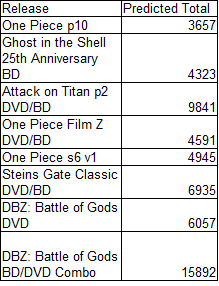
This time, my guess (9841 copies) was only off by 8 percent. That qualifies as a pretty successful test. If the S=(6944*(R^-0.4))-60 formula can ballpark the rest of this list successfully (at least, for the ones that chart), I think we may have a keeper.

Fun With Numbers: Updated US Amazon Formulae

Since late February of this year, I’ve been tracking the daily ranks of various anime releases on US Amazon to see if they could be used to get an idea of how releases were selling in the US, since that data is sparsely available for modern titles (especially unpopular ones). In March, I made my first stab at a formula which might tie thos edaily ranks to sales totals. In May, I realized that first model was based primarily on Holiday season sales charts and thus severely overestimated the market, and introduced a simpler one making use of more data. That model seemed for a time like it would be serviceable, pegging the sales of DBZ’s season 3 BDs to within 20%, but then it overestimated Attack on Titan part 1 by a factor of 3. Since I had no other test cases for my model available for the next few months, I was able to put off refining that model, but with data for the second part of Attack on Titan, the surprisingly successful Steins Gate rerelease, and DBZ Battle of Gods set to come out over the next few weeks, it’s a good time to use the data I’ve gathered to try and test a different model.

Continue reading

Fun With Numbers: Industry Valuation of In-Betweening vs. Voice Acting

Note 1: Corrected to account for more typical anime framerates (8-12 fps), rather than 24 fps.

If you’re going to be making a piece of animation, you’re obviously going to need some animators to draw some things. But anime budgets are tight, and the production costs in the industry are such that animation might not always be the best way for directors to maximize the bang they get for their buck. Anime salary data is pretty sparse, but I found enough information on certain costs to do a quick, naive calculation comparing the relative worth of in-between animation and voice acting.

Continue reading

Fun With Numbers: Kishi Seiji’s Rough Road

Way back in 1960, the NBA’s Cincinnati Royals drafted future hall-of-fame basketball player Oscar Robertson with the first overall pick. In his first season, he was named rookie of the year. In his second season, he became the only player in NBA history to average a triple double (i.e. putting up ridiculous stats in 3 separate historical categories). In his fourth season, he was named the league’s most valuable player. In his fifth through seventh seasons, he never made it past the first round of the playoffs. In his eighth through tenth seasons, he didn’t even make the playoffs despite putting up consistently great personal stats. In his eleventh season, on a new team with the man who would become Kareem Abdul-Jabbar, his team won a then-record 20 games in a row and eviscerated opponents in the playoffs, winning him his first-ever NBA title.

Robertson was great for basically his entire career, and it’s not like he lost those skills when his teams weren’t winning. So then why didn’t they win? Because in team sports like basketball, teams matter. When his team’s second-best player is a 41-year-old coach coming back into the game as a publicity stunt, how good a player is doesn’t much matter. It still takes good players to win championships, but great players not named Michael Jordan don’t win championships alone.

Anime production is not very much like basketball, but it’s a similarly complex process where circumstances can contribute as much as individual skills do to the net result. Before work on a show can even start, a producer has to successfully pitch an idea to sponsors and justify the business side of operations. A capable cast and staff have to be assembled. Those staffers then have to both have to develop an clear vision for the series and adequately communicate that vision with the hundred-plus animators who typically work on a modern TV anime. And for the project to be a success, that vision then has to resonate with its target audience, something which just doesn’t always happen.

I mention all this because it pertains very much to the discussion of director Kishi Seiji, one of only four directors in the history of anime to helm 3 non-sequel 10k+ hits, and the only one to do so at three separate studios. In spite of having set a career milestone that puts him on the same spreadsheet as Tatsuyuki Nagai and Yoshiyuki Tomino, Kishi has been a constant target for all sorts of fan ire. Taking a quick look at his career, it’s fairly easy to see where this sentiment originates. After a barely-notable start to his career, Kishi spent the years between 2007 and 2010 knocking off three straight winners (Seto no Hanayome, Astro Fighter Sunred, and Angel Beats) and making a bit of a name for himself. Angel Beats, for all its success, has its fair share of detractors, but the majority of bad mojo Kishi has generated comes from the next 3 years of his career, the stretch from 2011 to 2013, that made him one of the many to earn the nickname “the Uwe Boll of anime”. I categorically reject this label, not because all of the shows he directed over that stretch were good, but because the stretch was a daunting one in a way people rarely think about (and included some impressive achievements regardless).

Continue reading

Fun With Numbers: Visual Novels, Pseudonyms, and the Mainstream

Among other things, this Fall season features a pair of intriguing visual novel adaptations, Grisaia no Kajitsu and Daitoshokan no Hitsujikai. The two are somewhat dissimilar titles, but have quite a bit in common on paper; both series are quite popular (the franchises took the #4 and #1 spots in they getchu 2013 rankings, respectively), and have already won their share of hardware (Grisaia at the 2011 moe game awards, Daitoshokan in the 2013 getchu user awards). Perhaps even more interestingly, both series ostensibly swapped their original PC voice casts for new ones in advance of the anime. I say ostensibly because they didn’t actually swap their casts out at all; the same people who have been doing the voices for the franchise from the beginning will be doing the voices for the anime adaptations. This is also the case for the third non-Fate VN adaptation of the season, Ushinawareta Mirai wo Motomete. In practice, the reasons for these name swaps are fairly straightforward – voice actresses tend to avoid using their real names when voicing works that contain adult content.

Looking into recent history, I found a number of such cases where the original VN cast dropped pseudonyms to work on the anime version, with such titles making up a plurality of non-sequel VN adaptations over the BD era. That same history suggests that some combination of factors contributes to higher odds against them making it big as anime.

Continue reading

Fun With Numbers: October 2014 US Amazon Data (Initial Numbers)

October figures to be an interesting month, the second in a row headlined by multiple releases likely to chart. The most obvious is DBZ: Battle of Gods, which has the combo pack at 138th place a week before release. GitS: Arise and Hellsing Ultimate also have respectable probabilities of ranking given good thresholds; Ultimate is basically in the same position Steins Gate was in a month ago, and that release encouragingly broke into the lower 200s today.

Continue reading

Fun With Numbers: Appleseed Alpha Sold 11,093 R1 BDs in Week 1

As you may be aware, I track US anime releases on amazon, ostensibly to get a rough idea of how much particular lower-end titles might be selling. However, the titles I track each month come from amazon’s anime tag, which is not always applied to all anime-related releases. That’s what happened with the US release of prequel movie Appleseed Alpha on July 22 of this year. This is an issue because the BDs of this movie sold over 11k units in their first week on sale, via TheNumbers. It’s a lost opportunity because I could have used it to test predictions, but the datapoint itself is still somewhat interesting in its own right.

AA’s total is only 655 fewer copies than that of Attack on Titan’s first set, and that’s without accounting for the fact that the movie’s release was split between BD and DVD versions (as opposed to AoT, where the release was a BD/DVD combo pack counted as BD sales). Attack on Titan may well have the longer sales tail, though; it’s currently ranked at 1,022 while Appleseed Alpha fell back to 6,819 in Movies and TV. It’s worth noting the potential contrast between the two fanbases, one older (and presumably salaried) versus another younger and more casual.

(A screencap of relevant week’s BD sales chart is included after the break.)

Continue reading

Fun With Numbers: The Big Range of Big Underestimates in Oricon Weekly Manga Totals

One thing I can’t say enough is that data should be interpreted with a healthy amount of caution and second-guessing. This is especially true for manga charts, when a combination of ridiculously high weekly thresholds and the desire to have fast data on the effects of currently-airing anime can lead to some very incomplete and erroneous interpretations of the facts.

I’ve already done a few case studies on how Oricon and publisher claims can differ for series where the publisher boasted of some particular print total (usually in an insert on a volume of the series or a magazine). Those cases are enlightening, but not necessarily general, since there’s a heavy element of volunteer bias involved in which series get their totals reported. Recently, though, I found a fairly large list of distributor claims of print volume totals (via Shuppan Shiyou, see post #99 here), which contains latest-volume printing data for over 100 series published in 2013. It still isn’t totally general, but is at least a tad more representative of manga at large. In order to get a better idea of how much Oricon underestimates the “average” series, I took the weekly-charts total for a volume and compared it with the given print total for the same volume. The results of this comparison (which can be found here) highlight some large and inconsistent discrepancies between the Oricon figures and the official publisher totals.

Continue reading

No-Name Banknotes: Under the Dog’s Encouraging Success

29 days ago, on August 8, 2014, Creative Intelligence Arts launched a kickstarter for an original Masahiro Ando/Jiro Ishii anime project, Under the Dog. Yesterday, that project reached to reach its $580,000 funding target, and currently has an average of $68/backer from 10,486 total backers as of this writing. The success of this particular kickstarter, one of 5 anime-related ones that I am aware of (not counting anime sols projects), is obviously a good thing for the makers, and is also an encouraging sign for the future of anime crowdfunding.

Before I start, I should note that I didn’t fund the kickstarter because it didn’t seem like something I would watch if it existed today. I’m not going to be a poser and say I was a super-huge fan of this when I wasn’t. Academically, though, the project carries a few interesting implications that are really permutations of one big thing – it lacked a lot of advantages that previous such projects have had.

Continue reading