I just spent the past week and a half or so writing about how the anime industry responded to various changes in technology over the years. While I was writing those articles, I noticed that the changes occurred roughly every five years or so, and, going by that observation, we were “due” for another change soon. While the notion of things being “due” in general is a fairly foolish one, it did serve as the spark for a brainstorm about where that change might eventually come from. Eventually, I came across two possibilities that I felt were worth talking about: Web Anime and 3DCG anime.
3 Major Anime Industry Sea Changes Explained By Their Effect on TV Anime (Part 3: Blu-Ray Boosting)
Every so often, the anime industry goes through a metamorphosis and comes out on the other side looking a bit different. In parts one and two of this series, I covered how late-night TV timeslots altered the landscape of how adult-oriented anime was produced and how the switch to digital painting affected both the abundance of shows made and the predominant artstyle. Unless you believe that we’re in the middle of the beginning of another one right now with Net-only full-season shows or 3DCG shows,* the most recent major sea change to beset industry was the introduction of Blu-Rays, which came into the field in late 2006 and were making up the majority of sales for most adult-oriented anime by 2009.
Manga Chapter of the Week: Steel Ball Run Chapter 46 (Promised Land: Sugar Mountain 2)
This weekend, I sunk my teeth into the seventh installment of the Jojo’s Bizarre Adventure series, cheating a little bit as far as part order order goes.* It ended up being a very worthwhile decision, as I found the series contained bite after juicy bite of ridiculous (but not incomprehensible) content. It’s got everything from non-superpowered horse racing to dinosaur fights to spy-novel style infiltration scenes. It didn’t take me long to plow through the whole story, which integrates both a continental horserace and an epic bodyhunt. SBR is far from a perfect series,** but it’s got mad merits on writing and the way it uses full-page spreads to lay out a scene.
My favorite chapter of the series deals with a comically complex Stand/superpower that’s got abilities halfway between the Golden Axe fable and Leprechaun Gold. It works in the following way: the stand’s owner, Sugar Mountain, offers to return something that a person dropped, but offers both the thing dropped and a ridiculously more valuable version of the same (say you drop an Oreo cookie, she’ll offer you that or a two-pound cheesecake). If one answers honestly as to which they dropped, they get the works. They then have to use up both of those items in fair trades (i.e. they can’t just give them away for free) by sunset the day they receive them. If they fail to do both of those things, they turn into trees like so:
Yeah, it’s a little weird
So that’s the general setup, introduced in the chapter prior to this one. Also in the prior chapter, protagonists Gyro and Johnny managed to finagle a couple of necessary body parts off of Sugar Mountain by correctly negotiating the Golden Axe rule of her stand. Beyond the body parts, they’ve acquired a diamond, gold ore, a fancy watch, and $50,000 in cold hard cash. This chapter follows them trying to avoid becoming petrified wood by burning through their Leprechaun Gold via fair trade. All while being chased by a bunch of government assassins. If you think that sounds like the basis of a hilarious heist comedy’s third act, well, you’d be more or less on the money.
First Reactions: WataMote Episode 7
The montage segment at the beginning was a great way of demonstrating just how hard Tomoko was wasting her summer vacation. Each individual action she took was a different kind of low-brainpower activity, and her internal feelings about the day afterwards provided rock solid confirmation that that moment six minutes in where she looked like a Cleveland fan circa January 17, 1988 was coming. My favorite part of that segment was her commenting on the video, a little piece of satire directed at people no doubt commenting on the episode the same way. Mashing w is definitely a thing that happens, and he facial expression was a great example of someone showing exaggerating their sarcastic response to ridiculous internet crap.
It’s debatable whether or not its subjects got the joke
First Reactions: Space Brothers Episode 70
I had really hoped this show would discontinue the overtly racist Mr. Hibbit segments. But no, that’s still there.
At least there were some promising developments in the show proper.
3 Major Anime Industry Sea Changes Explained By Their Effect On TV Anime (Part 2: Digital Paint and DVDs)
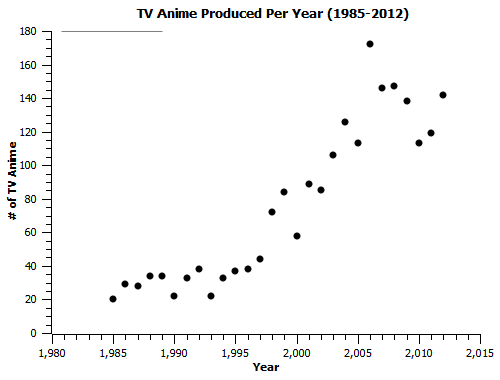
Welcome to part 2 of this series on how different changes in production and distribution methods affected anime over the years. Last time, I talked about how late-night TV anime came to be the norm for the industry, bringing with it free advertising and the ability to pursue more adult storylines in longer-form media than OVAs (the previously preferred form of adult-oriented anime). The impact of that still plays into today’s topic, though it’s not the subject. This time, the focus is on a pair of subsequent changes that led to still-further increases in production (the second big jump on the graph below).
The first half of the 2000s saw 2 meaningful changes affecting the anime industry. First, studios switched over from old-school cel painting to a digital paint process, reducing production costs and causing a subtle shift in both artstyle and visual presentation. Second, people started buying DVDs over VHS tapes, further reducing production costs (Incidentally DVDs being cheaper to produce than VHS tapes was a key cause of the 2007-2008 WGA strike in America).
First Reactions: Dangan Ronpa Episode 7
Without a doubt, the most impressive thing about this show is the sheer number of ways they’ve managed to work in a Monokuma enjoying himself in the background. This time might have been my favorite, because you can just barely tell he’s now using the Oowada butter on his pancakes.
Hot-blooded, so it melts in your mouth
Manga Chapter of the Week: Natsu no Zenjitsu 18 (A Day at the Beach)
Scans for this chapter apparently came out a long time ago. I can’t not talk about this series. The art is too good, the characters too engaging, the storyboards too crisp. This chapter follows the lead couple, Tetsuo and Akira, on a date to the beach as the former is recovering from some weird but very profound depression and makes good use of shading to show that off.
This chapter doesn’t contain that much in terms of raw plot. Its entirety consists of 3 scenes: Tetsuo arriving at Akira’s apartment late and without the canvas he had discussed bringing along, the two on the train with Tetsuo acting increasingly awkward, and the two at the beach. The first two scenes serve to show Akira noticing how off Tetsuo is, and the third scene is about Tetsuo swimming out into the depths before eventually coming back to Akira and just lying there. It’s a relatively simple premise for a chapter packed with emotional nuances that lend it a ton of depth. It’s harder to go into more detail without simply breaking it down panel-by-panel, but the manga does a particularly excellent job this chapter of illustrating Tetsuo’s improving mood by dramatically shifting the shading from dark to light as he swims back towards Akira. This dynamic results in a number of very touching, tranquil pages like the one below, pages that make the manga a very easy one to read over and over.
First Reactions: Free! Episode 6
Showing is superior to telling, but not all showings are created equal. One of the ways to tell a high-class pro director from a replacement-tier one is the way they make a situation clear with the first snap of the camera. Case in point: those first 3 seconds of that shot after Haru saved Makoto. The way one set of feet was dragging and the other was limp immediately spelled out what was going down. Mix in effective not-use of music (just rain and heavy breathing), and you get an immediate impression of the state Makoto was in. It was a bit of imagery that felt like something adapted from an award-winning manga, except Free is a novel adaption that had to make its own storyboards.
One look and it’s pretty obvious someone’s not alright
3 Major Anime Industry Sea Changes Explained By Their Effect On TV Anime (Part 1: The Late Night Revolution of 1996-1998)
Every so often, the anime industry goes through a period of transition that alters how and for whom anime is made and distributed. Call them paradigm shifts or whatever; I call them sea changes. There are at least 4 major sea changes that I know of that have significantly altered the industry: the OVA boom of the late 80s/early 90s, the transition of TV anime from daytime to late-night from 1996-1998, the transition from cels to digital art in the early 2000s, and the Blu-Ray Era starting sometime between 2006 (when they were officially introduced) and 2009 (when they made up a majority of the market). Each one of these transitions had a unique and lasting impact on the industry. Unfortunately, I lack the knowledge to write with any real authority on the OVA boom. This article is the first in a 3-part series covering the latter 3 sea changes and how they influenced the production of anime over the past two decades.