Fun With Numbers: Anime as Light Novel Advertisments in 2012

Compared to 2011, 2012 represents an upswing year for the industry; more overall TV anime was being made. In addition to simply seeing more light novel adaptations, we saw several adaptations of finished series (Kotenbu/Hyouka and Chuu2koi) and single novels (Another, Shinsekai Yori). Those four are notable, but not within the LN data I’ve been using for my sample.* Perhaps because of the minor resurgence in the industry, we do see a bit of an increase in the number of series that performed in unexpected ways. The performance of light novels which were adapted in 2012 in relation to the time frame their adaptation aired is charted below. The raw data is on this doc, and can be compared with the 2012 sample for manga.

Continue reading

Fun With Numbers: Anime as Light Novel Advertisments in 2011

Despite the fact that both get released in compiled volumes costing somewhere between 400 and 1000 yen a few times a year, the market for manga differs in many ways from the market for light novels. For one thing, it’s a much smaller scale market; the most popular light novels sell hundreds of thousands of copies immediately after their release, rather the millions that One Piece/Fairy Tail/Attack on Titan bring in. Too, light novel adaptations tend to succeed much more as a function of their initial popularity than manga does. To get an in-depth look at how anime adaptations of light novels have impacted the source material, I’ve plotted the sales for their first two weeks of solicitation over time, with the airdate of the anime superimposed. See this doc for the raw data, and compare the 2011 data for manga adaptations.

Note: I plot the two-week totals, rather than the one-week total, because even the average the first week total is vulnerable to a series that comes out on the last of the Oricon tracking period and having its sales numbers hamstrung. Kore wa Zombie Desu Ka had 4 volumes in a row come out on the last day of the week, obscuring a very real anime-fueled boost in sales.

Continue reading

Sell Me in 20 Minutes: Wizard Barristers

The first thing that struck me about Wizard Barristers was that the soundtrack wasn’t too great. The show opened with some great, serious action (and animation that, in terms of frames per second, is at least 90th percentile on the season), but the bgm had such a cartoony feel to it that it was hard to get invested in it at all.* Second of all, is it really best to open up a show nominally about lawyers with a death penalty case that gets closed within 5 minutes and after we hear no arguments? I mean, most first-world nations don’t have a death penalty, and those that do take a good deal of time to make sure due process has been carried out. From what I saw, the guy was tried once and burned to death on the spot. It doesn’t speak much in favor of the rule of law in this particular Wizard society, sucking a lot of momentum out of the world the delightfully tacky character designs were trying to build around. The subsequent introduction of the female lead felt like an earnest attempt to get past that, which I can respect, but from then on the episode just felt too straightforward to be engaging.* Too, the dialogue throughout the episode was off somehow. It felt like too many characters were speaking single lines and and the script contained very few real conversations, which made it hard to emphasize with the machinations of the investigation/pretrial process. Sunday’s too crowded with stuff that’s good now for something that might get better later, so this one’s a drop.

*This is one of those places where I feel like an expanded first episode would have helped. Law and Order paces out legal drama over 40 minutes, which really adds real tension to each case. Dangan Ronpa took roughly the same time interval for each case. Half of a 20 minute episode here didn’t feel like nearly enough time.

Sell Me in 20 Minutes: Sekai Seifuku and Nisekoi

Somehow, this is already the last day of the season where we’re getting multiple new shows on the same day. I suppose there’s also a common thread that both had a certain degree of visual distinctness, coming as they did from strong directorial stock.

Continue reading

Sell Me in 20 Minutes: Wake Up, Girls and Nou-Rin

We’re approaching the end of the Winter slate, and we’ve finally hit on the biggest economic-side enigma of the season. Wake Up, Girls had an unusual setup that, nominally, required viewers to watch the movie before the first episode. It’s an interesting setup from a commercial perspective, to say the least. I talked in my post about the upcoming Tamako Love Story movie about how movie sales could be an effective way to tap a larger, less enthusiastic fanbase. Based on the fact that the show is targeting fans from a similar demographic to Love Live’s upcoming season 2, the argument is that it’d be better to get something than nothing. But to make that movie ticket and 50 minutes of time a required entry fee to the franchise seems less advisable. You might simply end up with a really small fanbase if you don’t let them test the waters for free; even if otaku audiences are more willing to burn money on things they might like, this is a season with two sequels to 10k+ shows in the mix for their attention. I didn’t watch the movie and skipped straight to episode 1, because I’m not spending 70 total minutes on an unknown quantity from a director I dislike, general principles or not, until and unless it becomes a known plus.

Continue reading

A Pre-Wake Up Girls Defense of the Much-Maligned Yamamoto Yutaka

Right now, the NBA is divided up into two 15-team conferences. One of them, the Eastern Conference, is a garbage fire which contains a total of 4 teams without a win-loss rate under .500. The other, the Western Conference, is a den of monsters run by hypercompetent GMs that contains 9 teams with a win-loss rate over .500, and, by NBA’s own power rankings, 6 of the best 8 teams in the sport. You take one look at those statistics, and it’s painfully obvious that, since winning a playoff spot requires a team to be one of the best 8 in its conference, the situations of teams that want to earn a playoff spot in those two conferences are as different as night and day. The current number 8 team in the East, Brooklyn, has a record of 14-21, or .400. There are a grand total of 3 teams in the West that can’t beat that record. But of the season ended today, Brooklyn would be a playoff team while the above-.500 Denver Nuggets would be on  the outside looking in. It’s not a particularly fair system, but it is the system.

If my straw example worked the way it was supposed to, it should seem pretty obvious that simple playoff seeding shouldn’t be the only measure of success or failure for a team. Because it’s so dependent on the team’s surroundings and circumstances that  if it is the sole measure of success or failure, some teams without any legitimate talent are going to be labelled successes due to everyone else around them making their task easier, and some teams with plenty of legitimate talent are going to be labelled failures merely because they got stuck in the basketball version of the Ultimate Showdown of Ultimate Destiny at the exact wrong time.

The principle of judging something by circumstances, rather than simply by results, is a general one that extends well beyond playoff seeding. It’s even a problem that the advanced stats crowd in the NBA still struggles with to some degree. Just read Kirk Goldsberry’s take on how Monta Ellis went from being the league’s single worst shooter to an above-average shooter; the only real change that happened was Ellis switching teams to one where his teammates could actually play professional basketball and all of a sudden not being double-teamed on every play. When we judge people, their starting situation is always as important, if not more so, than the results.

But results are exactly how we judge the directors of anime. Part of this article is an uncomfortable level of #hottake that’s either going to look really stupid or really gutsy in about 3 hours. But the general sentiment is one I’d like to argue regardless, so here goes.

Continue reading

Sell Me in 20 Minutes: Sakura Trick and Hozuki no Reitetsu

A lot of stuff came out Thursday, and I don’t have a ton of time, so I watched the first 4 minutes of everything and decided to forego Pupa, Strange+, Mahou Sensou, and Z/X Ignition for varying degrees of spot check failure. The other two new shows did impress, and will be joining my weekly slate alongside The Show That Deserves The Jormungand Soundtrack and Takahiro Omori Unchained.

Continue reading

Get Behind the Bandwagon: The Added Fun Value From Loving Shows Some People Hate

To some extent, I’ve always been cogniscent of the fact that I’ve gravitated towards of a variety of indicators for the success of anime, rather than just word of mouth, because I have idiosyncratic tastes and using said variety of indicators helps illustrate that the case for or against many shows isn’t as clear-cut as many narrative-spinners would have you believe.

For the record, If there’s a worse anime blogger than Rick Reilly is a sports columnist, I’ve never met them. But I’ve read too many terrible columns by sanctimonious 70-year-old baseball writers about how Yasiel Puig has zero class and too many terrible columns by sanctimonious anime bloggers about how Kill La Kill is somehow “saving” an anime* industry that isn’t actually dying or lacking for fresh content not to see a lot of similarities between the two groups. I’m not saying that all writers who take a critical perspective on anime are like this, but far too many of them are more interested in grinding an axe against a genre rather than actually having a serious discussion about it.

But something hit me after I read this recent Andrew Sharp piece (he’s also the writer of the #hotsportstake series that mocks the aforementioned type of writing) about the appeal of bandwagoning on playoff football teams. One of his criteria that jumped out at me; “Does this team piss off Phil Simms and Jim Nantz?” I hadn’t thought about it for a while, but the Rex Ryan Jets were some of my favorite bandwagons for that very reason (plus the fact that those Jets played a defense best described as a shower of linebacker-shaped meteors backed by Darelle Revis eclipsing the sun). While my appreciation of a show is maximum when a show is great, my enjoyment of a show in a holistic sense is more of a 60-20-20 combination of 3 factors:

1. How much I enjoy it.

2. How well it performs commercially, usually in disk sales but potentially in other categories. It has to at least be a lock argument for having had break even sales.

3. The presence of a persistent group of (for lack of a better word) haters. Not just people who sort-of dislike and avoid it, but people who can’t resist taking paragraph-long potshots at it any time it gets mentioned.

This means that, as good as Attack on Titan was, it’s not a max-entertainment bandwagon. No one of any consequence particularly hates the show, and it’s just done really well. By contrast, Girls und Panzer was a near-perfect bandwagon show, putting up megahit numbers in the face of a number of vocal and hilariously ineffectual critics (it would be on my shortlist already if I weren’t currently watching it). There is really nothing sweeter in fandom than watching a show pile up vocal critics and subsequently both be good and sell well in spite of them. This post contains my personal shortlist of series I’ve had the privilege of being a fan of long enough to watch them do the Shaq thing and dunk all over the place.

To clarify before I actually get to the list, I don’t believe it’s a bad thing to hold any particular set of opinions. I do believe it’s a bad thing to constantly spend time talking scrap about stuff you don’t enjoy, and more generally about the way things are, rather than actually doing something about it. If you’re so upset about the majority of anime that get made nowadays, put up and post links to the BDs of the series you do like on your blog, or just buy them yourself. It’s trivially easy to use amazon for that sort of thing in this day and age.

That said, here are my personal bandwagon favorites of the past several years:

Continue reading

Fun With Numbers: The Bimodal Nature of Light Novel Adaptations in 2011

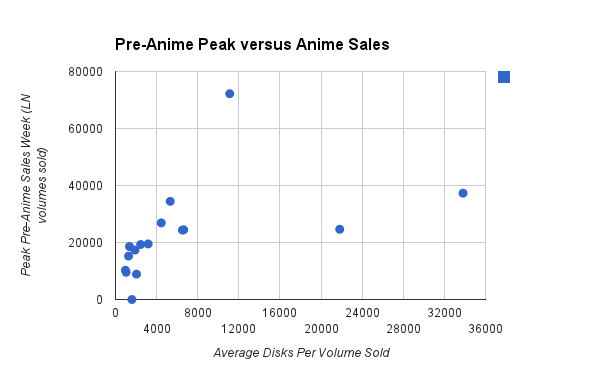
The sales levels of anime adaptated from manga are basically a crapshoot. Not so much Light Novels. Though I still haven’t compiled at the 2012 data, but one particular bit of information popped out of the 2011 sample that it deserves its own individual mention. It’s best described as 2 rules of thumb:

1. No LN series that had at least one week where a volume sold 20,000 copies in that week (disregarding cumulative totals) that went on to sell less than 4000 disks per volume. Only one (Mayo Chiki) sold less than 5000.

2. No LN series without at least one week where a volume sold 20,000 copies sold more than 4000 disks per volume. Only one (Kore wa Zombie Desu Ka?) sold over 3000.

LN_Peaks

Continue reading