Fun With Numbers: Normalized Google Traffic for Fall 2013 Anime

A big part of my goal is to take a look at existing numbers and see what can be gleaned from them, but that doesn’t mean I can’t take a stab at collecting new metrics. This post is just a summary of one rarely-used metric I’m curious in gauging the efficacy of, normalized google traffic, for anime aired in the Fall 2013 season.

Why check google traffic? It’s not complicated; most people with access to anime have access to the internet. And most people with access to the internet end up using search engines a lot. So you can (theoretically) get a good first-order approximation of how much relative interest an anime has generated by checking its search traffic volume against some other predetermined total (the volume of the term “Fall 2013 Anime” for the month of October is used here). By using volume for both the original Japanese and Romanized titles, it’s possible to parse the traffic in Japan versus the rest of the world. Show data is found on this doc, and listed after the break for the 38 Fall 2013 shows whose v1 data I’ve been using in predictive tests.

Continue reading

Fun With Numbers: Yuruyuri and the Oricon Threshold Iceberg

Towards the end of 2011, the chief editor of comic Yuri Hime, Naitarou Nakamura, revealed that Yuruyuri, a then-7-volume manga series which was adapted into an anime series in summer of that year, had sold over 1 million copies. That in itself isn’t a particularly rare feat; 49 different manga sold that many copies in 2011 alone, as did 15 individual volumes.

What makes Yuruyuri’s case particularly instructive, though, is that it had never appeared on the Oricon charts until June of 2012, 6 months after hitting said million copy mark. How is it possible that a series can hit that impressive a milestone without charting once? The short answer is that the Oricon charts are a very incomplete list. In the past 5 years’ worth of manga charts, we’ve never had a threshold that was below a five-digit number of copies. That means that, in theory, it’s entirely possible (if not extremely likely) for a series to sell 10,000 copies per week without its fans hearing a word about it. If this hypothtetical volume did that for 52 weeks, its total sales of 520,000 volumes would be 25,000 copies shy of the last series on the 2011 top 50 individual volumes list (One Piece’s first volume).

The above example is a bit extreme, but Yuruyuri’s performance isn’t that far off. There is a fairly strong limiting case we can look at to get an idea for how exactly Yuruyuri made it to the magic million (which required an average of ~143,000 copies sold per volume);  Assume the sales were entirely fueled by the anime’s popularity boost. The series had 7 volumes out for the period between the anime airing (on July 4th). Between July 4th and December 18th, there were a total of 24 weeks of Oricon sales charts. 1,000,000 copies/7 volumes/24 weeks=5950 copies/volume/week. The lowest threshold over that time period was 18,406 copies/week for one week in mid-October. Even if we assume that all of those sales were packed into the 12 weeks in which the anime was airing, that’s only up to about 11,900 copies/volume/week, still short of the most generous available threshold over that time period. In a less stringent case, if the manga was already half of the way to a million copies and the anime provided a more moderate boost (which would still have been doubling the series’ sales in a quarter of its previous 2 years in print), it would have been even easier for the series to remain entirely under the radar en route to the million-copy mark.

Yuruyuri had a successful anime, averaging about 8348 disks per volume, and thus didn’t need the manga success the way a lesser series might have. But it does serve as one of the more powerful counters to the idea that the success of a anime in advertising a manga necessitates an appearance on the Oricon charts. It also illustrates the fact that, when actually see big boosts in sales, those might be significantly bigger than just what we observe. The most successful manga advertisements, the crazy-chart Blue Exorcists, are easy to quantify. However, many series, even those that end up as clear-cut successes from an insider’s point of view, are not.* One thing that should always be kept in mind, especially when looking at manga for adults like Aoi Hana that packs a per-volume price tag (~1030 yen) twice that of newer One Piece volumes (~430 yen), is that a series doesn’t have to be making the Oricon charts at all to make its publisher happy.**

*I am guilty of oversimplifying these cases myself at times, so I can’t really blame other people for doing so. To wit, the gain-probabilities I name in this article are for minimum gains, not exact gains.

**Yuruyuri, by the by, runs about 930 yen/volume.
Fun With Numbers: Myanimelist Stats Predicting the Fall 2013 Disk Over/Unders

Edit: Link to source document fixed.

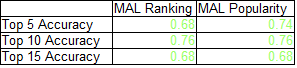
Like those of any other free-access site, or any one set of numbers, statistics from myanimelist should be utilized with caution. But that doesn’t mean they shouldn’t or can’t be used. In this article, I’m looking the current rank and popularity of 38 shows from the Fall 2013 on myanimelist to determine how they stack up against other methods of doing the same. As before, note that any accuracy below the best null hypothesis of .66 is fairly insignificant.

By the by, the myanimelist stats used in this piece were taken in late April, 2014. Odds are they’ve changed a bit since the outset of the season, though shifts within the season tend not to be particularly cataclysmic. Most can probably be viewed as in a similar boat to December Torne/eps 9-12 Nico ranks, in that they’re made when the audience has more information about the show (i.e. has seen more episodes). I used both rank/score and popularity/total number of users to order the shows, and then checked how many v1 sales using the top 5/10/15 shows on those lists correctly pegs as over or under 4000 disks. Data can be found on this doc, and the results are below (indicators greater than the null hypothesis in green):

mal-compTurns out, both indicators do about the same, both beating out the null hypothesis for all 3 list sizes. Out of the metrics I’ve examined so far, that’s the best overall performance. Of course, keep in mind that this is a fairly small sample, and there are other ways (notably source material sales) that these indicators may be telling. It’s still fairly early in the project to say much, beyond the fact that mal stats are at least a little more indicative than random chance.

Fun With Numbers: Nico Stream Rankings Predicting Fall 2013 Disk Over/Unders

Niconico stream rankings are one of the most frequently talked-about stats when it comes to early-season indicators of how a show might be performing. It’s been somewhat frustrating to me that they seem to get brought up at the beginning of every season, but how accurate their predictions were has never really been revisited. By comparing their basic effectiveness with the eventual disk sales results, hopefully we can get a little more context for how those numbers should be interpreted.

Nico ranks come with a couple of numbers attached, so I’m looking a couple of them to see which ones worked best. I use 3 metrics: the number of viewers at the end of the episode stream, the percentage of viewers who gave the episode a 1 (the max score), and the product of those first two (i.e. the number of users who gave the episode a max score). All 3 of these metrics were averaged over episodes 1-4 (October), episodes 5-8 (November), and episodes 9-10,11, 12, 13 (December). I then determined how accurate guesses based solely on these method would be if the top 5, 10, and 15 items on the list were assumed to have their first volume sell over 4k disks.

It should be noted that only 25 of the 38 Fall shows I’m using v1 data for have available Nico rank data, 9 of which had v1s sell over 4000 disks. In the interest of not polluting the sample, I’m just checking the accuracy of the rankings within the sample, excluding the other 13. This does leave the sample with a different over/under ratio than the full seasonal sample (36% instead of 34%).

Anyway, here’s how the various methods performed on the Fall data (detailed data here, breakdown doc here). Numbers for the ones that beat the .66 accuracy afforded by the best null hypothesis are shown in green:

nicoran-compTotal number of viewers arguably performed the best, besting the null hypothesis outright in October and December. Max rating % did very well when only taking the top 5, but fairly poorly otherwise (the top 15 models barely beat out a coin flip model). Max rating number was fairly spotty, except as a broad-strokes indicator in October and a top-tier indicator in December.

This is data taken from a fairly small sample, but these numbers do suggest that the top-tier of the rankings and the total # of stream viewers are at least better than random chance at picking which shows will succeed, something that couldn’t be said for most Torne DVR lists. How impressive that is depends on how well other indicators do and how well it holds up to an extension of the sample size.

Via Newtype USA: [inside] Madhouse

Along with an understanding of the broader context of the subject, the most vital ingredient to good anime coverage is a reliable source. So when US journalists actually interview people on the production side in Japan, it’s generally worth noting unless the interview consists entirely of fluff. This is the latest of what will hopefully be a couple more posts archiving articles from Newtype USA’s [inside] series of articles written by Amos Wong. This studio Madhouse feature includes Masayoshi Kawajiri and Kazuo Koike talking about their mentor-student relationship (and the differences between movies and TV), Producer Yuichiro Saito talks about the merits of doing all types of projects, and Hiromichi Masuda talks production-side differences between eastern and western animation.

Note: Pictures are scans of the article made on my crappy scanner, which cover the article text but not the entire page. They’re also in greyscale, because I’m interested in archiving interview text and color scans make the process more of a headache than it needs to be. Apologies for that. Scans after the jump, along with comments on the contents of the article.

Continue reading

Via Newtype USA: Hiroshi Nishikiori (August 2003)

Hiroshi Nishikiori, one of only 17 directors to helm multiple non-sequel 10k hits, offers some commentary on what was then his latest work, Gad Guard. One sidebar reveals that Gad Guard is actually inspired by Easy Rider. Which makes perfect sense.* (spoilery comment on said point after the article pics)

Continue reading

Via Newtype USA: Carl Macek (August 2003)

Carl Macek, creator of Robotech, talks about his production philosophy and what he views as compatibility issues between American and Japanese, as well dubbing Aura Battler Dunbine and the nuances of ‘old’ and ‘new’ when it comes to anime.

Continue reading

Via Newtype USA: NISIOISIN (July 2003)

I’m going back through the issues I already scanned some articles from, and it turns out that just about every issue has an interview with a novelist, some of them now extremely prestigious. This issue includes one with NISIOISIN a good two years before the Monogatari series, where he mentions about his personal writing speed record – 170 pages in a day.

Continue reading