Fun With Numbers: Pays to Shop Around

In my post-March piece on US amazon rankings, I noted there were other retailers that sold anime over the internet. I figured it was an important enough point that I took a look at the prices offered for the releases I’m tracking in April. Specifically, I took the MSRP for each of these 32 releases, and compared it to the actual prices offered at Amazon, Right Stuf, and Robert’s Anime Corner Store. Even a look limited to these three stores shows a pretty significant variation in which one offers the lowest price and how much (prices are in dollars and rounded up, lowest price in blue):
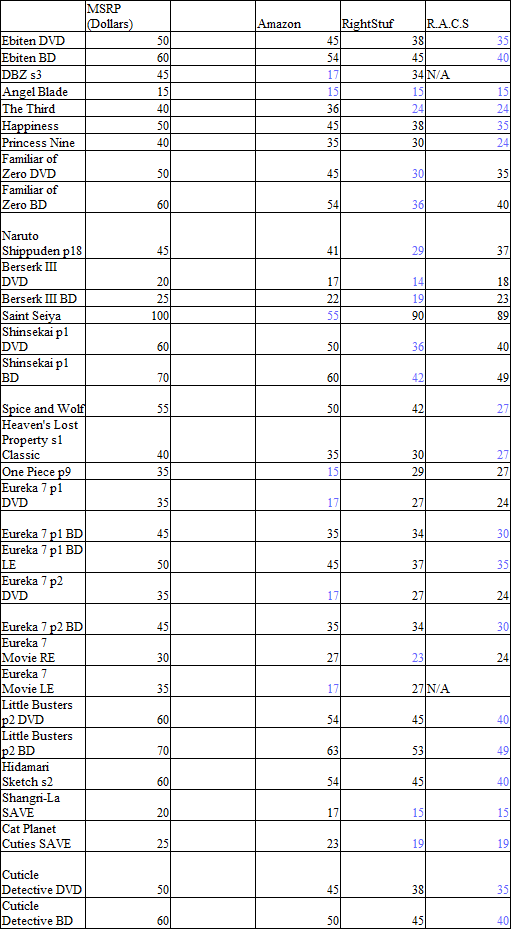
April-pricesNo one store has the consistent lowest price title sowed up. RACS seems to have be the bargain more of the time, and the amazon releases that are lower than the competition are much lower, but the relative price being offered really seems to depend on each release. Beyond helping me tweak my model and expectations for what US amazon can and can not be used for,* this list makes the millionth version of this point; if you’re going to shop for R1 releases, shop around.

*The rankings could still potentially be very indicative of the relative strength of similarly priced series, as stuff like shipping and service can cause people to prefer certain retailers. It comes down to whether amazon popularity is indicative of popularity elsewhere or not. Either way, it’s probably smart to expect Sentai releases with their lowest prices offered elsewhere to be underestimated by an amazon-only model.

Via Newtype USA: [inside] Bones (February 2003)

Along with an understanding of the broader context of the subject, the most vital ingredient to good anime coverage is a reliable source. So when US journalists actually interview people on the production side in Japan, it’s generally worth noting unless the interview consists entirely of fluff. This is the latest of what will hopefully be a couple more posts archiving articles from Newtype USA’s [inside] series of articles written by Amos Wong. In this one (the first chronologically in the series) President Masahiko Minami talks about the studio’s origins and namesake, Hiroshi Ousaka talks about research trips to Morocco, and Toshihiro Kawamoto talks about using digital effects to produce more effective POV shots.

Note: Pictures are scans of the article made on my crappy scanner, which cover the article text but not the entire page. They’re also in greyscale, because I’m interested in archiving interview text and color scans make the process more of a headache than it needs to be. Apologies for that. Scans after the jump, along with comments on the contents of the article.

Continue reading

Via Newtype USA: Toshihiro Kawamoto on the Cowboy Bebop Movie (February 2003)

I wasn’t planning on scanning this until I read it, but this one just so happened to contain some juicy tidbits. Toshihiro Kawamoto not only opens up a little about what the job title “Art Production Director” entails, and has a cool point about the cost of extra lines in character designs for anime movies (the more times you have to draw it, the more expensive it gets). He also mentions that Shinichiro Watanabe tends to be more hands-off in handling his staff, hence some of the fanservice in the motion-heavy scenes (in other words, kind of an entertaining polar opposite to Tsutomu Mizushima in 2012).

Note: I switched to greyscale here because I kept making mistakes in scanning the pages with small margins and it takes significantly less time than color per scan.

Continue reading

Via Newtype USA: Hanada Shonen-shi (February 2003)

Hanada Shonen-shi is an oft-overlooked series that holds a few unique fun-trivia attributes; it was one of the earlier shows in the awesome NTV 24:50 Tuesday slot and put up 3%+ ratings long before doing so was cool, and it’s got the only opener done by the Backstreet Boys. This brief spread talks about how the manga creator, Makoto Isshiki, was the one who pushed for that opener. There’s also an interesting comment on the voice actors practicing for a body-swap sequence. Not much text, but it’s neat.

Continue reading

Via Newtype USA: Yutaka Izubuchi and Ichiko Hashimoto on Rahxephon (February 2003)

Yutaka Izubuchi jokes about the length of the Eva manga, goes over designing his preferred style of face-bearing robot, mentions his Sunrise Production Planning Division connection with the director of Gundam SEED, and talks about getting gently nudged into the director’s chair by Masahiko Minami (President of Bones). Also, he get a pretty hilarious congratulatory card from Mamoru Oshii; “I don’t know why you don’t just quit… and don’t come crying to me when you fail!” More refuse for my “Is Mamoru Oshii just affecting that cranky demeanor he always has in interviews, rather than being legitimately bitter?” pile.

Continue reading

Sell Me in 20 Minutes: Mekaku City Actors

Mekaku City Actors packed a number of strong-side points, the mos enjoyable of which was hearing Asumi Kana at full blast. Just having her go at it with one-way dialogue did a great job of lightening up the atmosphere after that story-heavy intro. It’s fun to watch a character just grab the reins and take charge of a scene the way he computer avatar character did. A star-studded cast is almost a given for a high-budget production, but not everyone really makes use of their veteran VA’s strong points the way those minutes did. That’s one of the really fun parts about the deliberately minimal rorschach-blot style that has come to characterize that one studio whose name everyone has heard several times at this point; when it doesn’t work by itself, it’s setting a really open stage for writers and seiyuu to just jam. Oh, and it makes flipping the script on a dime doable as well (visibly useful in the second half). Warts be damned, I’m all-in on this one; it’s getting at least 3 more episodes.

Sell Me in 20 Minutes: Knights of Sidonia, Gochuumon wa Usagi Desu Ka, and Ping Pong

You can do most things with 3DCG as it stands now in anime, if you use it in a manner conscious of its limitations. But Knights of Sidonia didn’t feel like it was bringing any kind of production-side A-game beyond the first-2-minute action scene. The scene in the rice plant where the male lead was running away put way to much focus on motion that was very wooden, and it cut out of that scene with a very sloppy fade-to-black transition.* The show is just nowhere near as good as Arpeggio was at handling the weak points in its CG style, and it was missing opportunities by not, among other things, restricting walking exposition scenes like the one about the third gender to discretion shots. The mech scenes, at least, were smooth as silk. I kept watching, though, and development of what seems like a very Xenogears-y world got intriguing pretty quickly, thanks in part to effectively washed-out pale color palettes and in part to the fast-moving story (even before counting the cliffhanger at the end). I’m willing to give this one two more weeks.

Continue reading

Sell Me in 20 Minutes: No Game No Life and Hitsugi no Chaika

No Game No Life had some cool color schemes and showed some respectable chemistry for the main duo. Unfortunately, the games proper this episode showed off (a game of chess and a cheat-heavy game of poker) were written in fairly pedestrian ways. The presentation seemed a lot more focused on making the main duo into cool characters than it did on creating compelling scenarios. That approach can work in some cases, but it’s not doing it for me here. Dropped.

Hitsugi no Chaika managed the first couple of minutes peculiarly. I’m not really used to seeing action shows introduce their characters to each other in low-key comedy scenes; more often, they tend to either already know each other or encounter each other in the middle of a fight. I tend to prefer the latter, since it starts the show out at a faster pace. And while I did feel like the show was a bit of a slow starter, the lower-key scenes felt like they at least worked individually and the infiltration at the end where they had to figure out how to get the coffin in was actually kind of neat. I’m giving this one another week to introduce more of the story.

Fun With Numbers: Normalized Google Traffic for Spring 2014 Anime Thus Far

I keep forgetting google trends is a thing. It occurred to me that there’s a really basic stat available to measure an anime’s $0 popularity level. I’ve been tossing around the idea of trying to tinker up an effective way of displaying variance anime fanbase size by cost, and how much google search traffic it generates is likely a pretty good approximation of the lowest possible end of that. I searched the spring anime which have aired thus far (via mal, skipping the shows with 2000 members or less) on global google trends in both their official Japanese and Romanized titles, normalized against the term “Spring 2014 Anime”.

Obvious caveat – some of these series go by alternate titles, so the romanized search traffic may not be all of it.

Also, somewhat unexpectedly, series like Baby Steps and Black Bullet with full-English titles still see peak traffic this month. I guess phrases have to be pretty popular to beat out kids looking for free streams of anime. Love Live still seems fairly inflated, though (considering how much of its English title traffic was the same pre-2012).

Continue reading

Via Newtype USA: Yousuke Kuroda and Yasunori Ide on Onegai Twins (November 2003)

Or: An article in which Yousuke Kuroda takes the time to tell blatant lies about Yasunori Ide within his earshot. It’s not something I see particularly often – the writer and director both get interviewed simultaneously and bounce off each other a little bit, giving off fun hints of the chemistry they might have had working together for two seasons on the same series. The two then talk about their desire to get away from typified one-keyword heroines and move towards less simple, more realistic characters (taking what may or may not be a subtle jab at 13-heroine Sister Princess in the process). The second page also has a blurb on the beautiful scenery of Lake Kizaki, the source of the franchise’s top-5 all-time background art.

Continue reading