Fun With Numbers: Statlines for the Video Game-Anime Adaptations of 2012

The investigation into video game source popularity (started with 2011 data here) continues into 2012, where, despite an increase in the total number of shows aired, the number of game adaptations remained almost constant (rose from 9 to 10) and the total number of 10k+ shows actually went down (from 4 to 1).

To recap the meaning of these numbers; in order to get some idea of how existent and/or strong the video game franchise popularity -> anime popularity -> added video game franchise popularity chain is, I pulled a pair of stats for each of the 10 video game adaptation anime made in 2012 that I have data for. The 2 stats I chose to measure video game popularity were maximum yearly rank of the franchise on popular VN retailer getchu (mildly NSFW) and total console game sales for games released within one year of the anime’s initial airdate, via vgchartz. Data is archived here, and summarized on the chart below.

Continue reading

Sell Me in 20 Minutes: Isshukan Friends and Kanojo no Flag wo Oraretara

Isshukan Friends was set up by pretty much all the promotional material as a heartwarming drama, which made the fact that it was a 4-koma adaptation an interesting one. We’ve seen exceptionally well-handled 4-koma adaptations very recently*, shows that succeeded by building a more cohesive flow out of the generously loose framework offered by the source. Apparently, that’s an approach that works just fine for a more somber atmosphere. This episode did a great job of varying the mood from somber to lighthearted as needed, keeping conversations flowing while mixing in background cutaways and other spices to break up the action between days. It helped that said background art was pretty great by itself (even if it played a minor role). I’ll be spending three more episodes on this one, since it seems to have a vice grip on its identity right off the bat.

Isshukan-2Reminds me a lot of Kare Kano, which is just about the second-highest background-related compliment I could give

Kanojo Flag didn’t have super-polished animation at any phase in time, but it did pack a level of fun energy into most of the show. The characters weren’t jump-off-the-screen interesting, and there was a fair bit of flashback melodrama bogging things down to a degree. But the opener seemed to get a lot of mileage out of the “flags as physical manifestations of the power of narrative” schtick, which was equal parts clever and funny and made for a cute climax. You can build a show around that if it gets used like it was this week. I’ll give this one another two episodes to build up a cast and a broader arsenal of jokes.

*Vis a vis Sakura Trick and Seitokai Yakuindomo Footnote.

Fun With Numbers: March Amazon Data and Ambiguity

Having 2-3 times as many datapoints does usually make things more clear, except when it doesn’t. Adding March releases to the set of amazon rank data I’ve been gathering did help fill out some of the plots, but it also brought me face-to-face with some very real points I overlooked last time around. At any rate, it’s been an informative month of data gathering (table’s here, if you’re interested). This post is mainly an update on where I stand right now on this cf of an analysis project, with a recap of points addressed last month, a summary of the other things that came up, and an *extremely* rudimentary sales estimation model.

Continue reading

Sell Me in 20 Minutes: Kamigami no Asobi and Captain Earth

I was planning on capping my Saturday viewings with Captain Earth and Ace of the Diamond in a one-two whammy, but I saw Kamigami no Asobi up there on crunchyroll and decided to give it a few minutes of consideration. In return, I was treated to an intriguing, if somewhat incoherent fight scene, a very out-there transformation sequence, and a school life first day of vacation sequence that mixed in plenty of casual walk-and-talk to keep things moving. The big mystery in that first half of the episode was how the show would handle that transition from crisp slice-of-life to Greek gods burning their cosmo in battle, and while the transition wasn’t an elaborate one, it did have a whimsical feel thanks to a flighty soundtrack. The character intro bits were a bit overdone, but were more interactive than monologue-based, which counts for a bit. I’m keeping up with this one for at least another week.

Captain Earth was the show I personally thought had the highest if-everything-goes-right ceiling heading into the season, with the caveat that it was probably less likely to reach that ceiling than a few other shows. This episode didn’t take a great first step in that direction, jumping around a lot between scenes in a way that felt fairly choppy. I hate that sort of format; while quick pacing that focuses exposition as nice, the most enjoyable scenes are the ones that come from flowing continuity. That said, the part of the flashback that featured the two kids bonding and surprising each other was engaging, and they got more coherent as the episode went on. Less encouraging was the soundtrack usage, which was super-unbalanced; it felt like it was just out of sync with the atmosphere the show was trying to build in a good 30% of the scenes (particularly the gravesite/death flashback one where some upbeat Space Brothers-esque inspirational stuff was playing). It’s like they just left the music on play, rather than fitting it to the scenes at hand. After the choppy first half, the whole thing was a short intro for the first villain and a very elaborate docking sequence. I’m gonna give it some time because a fight has yet to happen and it still does have potential to build out the story, but this episode did not inspire much in the way of confidence.

Sell Me in 20 Minutes: Sound Robot Daimidaler, Mahouka Koukou no Rettousei, and Soredemo Sekai wa Utsukushii

Daimidaler was split between pervy humor that felt fresh and organic (the uniform scene at the beginning, everything penguin-related) and stock pervy humor. While there was enough of the latter that I certainly wouldn’t be watching it in a group, I felt like the former made a stronger impact. Between the comedy and the wicked hot-blooded/punny intro, I’m happy to see where it goes on a week-to-week basis.

Continue reading

Fun With Numbers: Statlines for the Video Game-Anime Adaptations of 2011

I may have mentioned this before, but nailing down the impact of anime on video games (released on irregular timetables and with less baseline-dependent variance in stats) is much harder than ballparking the same effect for manga or light novels (where volumes are released at regular intervals and can generally be seen to follow a pattern in the absence of strong outside stimuli). Too, while sales tools exist for measuring the success of console video games in Japan, those tools are much less viable when it comes to measuring the effects of typically PC-based visual novels. Still, roughly 10 anime are adapted from games every year, and it’s a very important part of the market to understand.

In order to get some idea of how existent and/or strong the video game franchise popularity -> anime popularity -> added video game franchise popularity chain is, I pulled a pair of stats for each of the 9 video game adaptation anime made in 2011 that I have data for. The 2 stats I chose to measure video game popularity were maximum yearly rank of the franchise on popular VN retailer getchu (mildly NSFW) and total console game sales for games released within one year of the anime’s initial airdate, via vgchartz. While it should be noted that this was a small sample taken in a year with slightly fewer new shows, the results are potent fuel for speculation. Data is archived here, and summarized on the chart below.

Continue reading

Sell Me in 20 Minutes: Selector Infected Wixoss, Akuma no Riddle, and Stardust Crusaders

I’m not blogging stuff seasonally anymore, but that doesn’t mean I don’t enjoy the 2-week airing period where every show is tasked to grab viewers with the most compelling start it can manage. I’ll be posting very brief summaries of how much the Spring 2014 intros pulled me into their respective shows as the season goes on.

Continue reading

Unstoppable Hype Machine Spring 2014 #1 – Puchimas! Season 2

Download it!

There are going to be people who disagree with the Machine. People who are going to say that other shows are better then the second season of literal idol moeblobs.

But the Machine is (probably) never wrong.

And the Machine is ready to show you why Puchimas! Season 2 is something to be hyped for.

Unstoppable Hype Machine Spring 2014 #2 – Mekaku City Actors

Download it!

Number 2 on our (slightly delayed) list is Mekaku City Actors, the newest project from both Akiyuki Shinbo, director of Madoka, Bakemonogatari, and Nisekoi, and the mind behind the Vocaloid designs. The associated light novels have been tearing up the charts for months and the Hype Machine has been building up!

Fun With Numbers: Amazon Rank Progression for US Releases (March 25)

Note: The part 3 of the series on composers is on hold for a little bit. I got pretty deep into the rabbit hole and want to actually listen to the stuff these guys wrote to see if their big pieces have common elements. Since music is more passive listening, it’s somewhat feasible, and is an important part of looking at what that junk stat means, if anything.

And speaking of articles delayed way longer than I expected them to be, game adaptations! While console game sales are somewhat reliably available via the numbers, PC VN data is not, so they can’t be reduced into a plottable stat in the same way that manga and LNs can (the latter’s data are still incomplete due to thresholds and long tails, but big gains are usually obvious because of there’s a baseline to compare them to). I eventually decided to start breaking them down as a two-number stat line; highest yearly rank on VN retailer getchu and console sales via vgchartz, both within one year on either side of the anime airdate. I hope that I’ll be able to start posting those 2011/2012 stat lines before Scottie Wilbekin wins me real money in my March Madness pool, both of which I have now successfully jinxed. Anyway.

This is the last individual/plot post I’ll be doing for the March US releases I’ve been tracking. The full sheet of data is available here. I’m doing tracking for several April releases as well, and will continue to do so so long as there look to be more questions worth the daily effort of collecting the figures. An analysis post, comparing some of the narratives I touched on earlier with the new data, discussing other points to attack with a sample that will continue to grow, and making very, very tentative factor-of-two sales estimates based on extrapolation from somewhat known low-end and high-end daily totals will (hopefully) be up sometime this week. Speaking of the low-end, here’s the last chart for the performance of that Aria the Natural release:
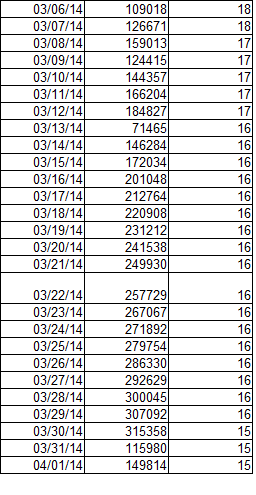
Aria-wk4Chart is date, rank, # in stock

Thankfully, I got the sale I needed this week. It seems like a single sale is enough to bump an item ranked 300,000th down under the 120,000th place no-sales line. Good to know.

Plots are posted after the jump.

Continue reading