Fun With Numbers: Statlines for the Video Game-Anime Adaptations of 2012

The investigation into video game source popularity (started with 2011 data here) continues into 2012, where, despite an increase in the total number of shows aired, the number of game adaptations remained almost constant (rose from 9 to 10) and the total number of 10k+ shows actually went down (from 4 to 1).

To recap the meaning of these numbers; in order to get some idea of how existent and/or strong the video game franchise popularity -> anime popularity -> added video game franchise popularity chain is, I pulled a pair of stats for each of the 10 video game adaptation anime made in 2012 that I have data for. The 2 stats I chose to measure video game popularity were maximum yearly rank of the franchise on popular VN retailer getchu (mildly NSFW) and total console game sales for games released within one year of the anime’s initial airdate, via vgchartz. Data is archived here, and summarized on the chart below.

Continue reading

Fun With Numbers: March Amazon Data and Ambiguity

Having 2-3 times as many datapoints does usually make things more clear, except when it doesn’t. Adding March releases to the set of amazon rank data I’ve been gathering did help fill out some of the plots, but it also brought me face-to-face with some very real points I overlooked last time around. At any rate, it’s been an informative month of data gathering (table’s here, if you’re interested). This post is mainly an update on where I stand right now on this cf of an analysis project, with a recap of points addressed last month, a summary of the other things that came up, and an *extremely* rudimentary sales estimation model.

Continue reading

Fun With Numbers: Statlines for the Video Game-Anime Adaptations of 2011

I may have mentioned this before, but nailing down the impact of anime on video games (released on irregular timetables and with less baseline-dependent variance in stats) is much harder than ballparking the same effect for manga or light novels (where volumes are released at regular intervals and can generally be seen to follow a pattern in the absence of strong outside stimuli). Too, while sales tools exist for measuring the success of console video games in Japan, those tools are much less viable when it comes to measuring the effects of typically PC-based visual novels. Still, roughly 10 anime are adapted from games every year, and it’s a very important part of the market to understand.

In order to get some idea of how existent and/or strong the video game franchise popularity -> anime popularity -> added video game franchise popularity chain is, I pulled a pair of stats for each of the 9 video game adaptation anime made in 2011 that I have data for. The 2 stats I chose to measure video game popularity were maximum yearly rank of the franchise on popular VN retailer getchu (mildly NSFW) and total console game sales for games released within one year of the anime’s initial airdate, via vgchartz. While it should be noted that this was a small sample taken in a year with slightly fewer new shows, the results are potent fuel for speculation. Data is archived here, and summarized on the chart below.

Continue reading

Fun With Numbers: Amazon Rank Progression for US Releases (March 25)

Note: The part 3 of the series on composers is on hold for a little bit. I got pretty deep into the rabbit hole and want to actually listen to the stuff these guys wrote to see if their big pieces have common elements. Since music is more passive listening, it’s somewhat feasible, and is an important part of looking at what that junk stat means, if anything.

And speaking of articles delayed way longer than I expected them to be, game adaptations! While console game sales are somewhat reliably available via the numbers, PC VN data is not, so they can’t be reduced into a plottable stat in the same way that manga and LNs can (the latter’s data are still incomplete due to thresholds and long tails, but big gains are usually obvious because of there’s a baseline to compare them to). I eventually decided to start breaking them down as a two-number stat line; highest yearly rank on VN retailer getchu and console sales via vgchartz, both within one year on either side of the anime airdate. I hope that I’ll be able to start posting those 2011/2012 stat lines before Scottie Wilbekin wins me real money in my March Madness pool, both of which I have now successfully jinxed. Anyway.

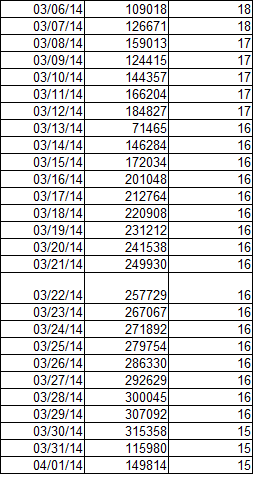
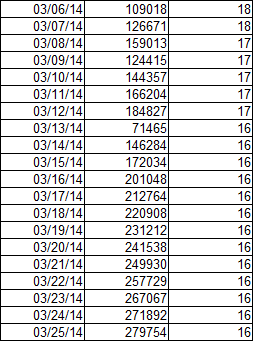
This is the last individual/plot post I’ll be doing for the March US releases I’ve been tracking. The full sheet of data is available here. I’m doing tracking for several April releases as well, and will continue to do so so long as there look to be more questions worth the daily effort of collecting the figures. An analysis post, comparing some of the narratives I touched on earlier with the new data, discussing other points to attack with a sample that will continue to grow, and making very, very tentative factor-of-two sales estimates based on extrapolation from somewhat known low-end and high-end daily totals will (hopefully) be up sometime this week. Speaking of the low-end, here’s the last chart for the performance of that Aria the Natural release:

Aria-wk4Chart is date, rank, # in stock

Thankfully, I got the sale I needed this week. It seems like a single sale is enough to bump an item ranked 300,000th down under the 120,000th place no-sales line. Good to know.

Plots are posted after the jump.

Continue reading

Fun With Numbers: Amazon Rank Progression for US Releases (March 18)

Compared to last and next week, this slate of releases was a bit small, containing 3 rereleases (Zombie, Shana, To Love) along with 2 new releases (Upotte, Bleach set 20).

As before, here’s the rankings up to this week in Aria the Natural part 2, featuring one total copy sold and the majority of days spent ranked 120,000th or higher:

Aria-wk3

Chart is date, rank, # in stock

The decline in rank seemed to slow down this past week. I would guess that, once you get to the 200,000s, you hit a point where there are a lot more shows that haven’t sold in a while or at all, leading to a slower advancement. At this point, I’m mainly following the ranks to see if the series can drop back into the 70,000-80,000 range with the next purchase that gets made, or if the long drought will have significant effects on the post-purchase rank.

Plots are posted after the jump.

Continue reading

Fun With Numbers: April 2014 Amazon Data (Initial Numbers)

US amazon data may not be a perfect source, but it is a very interesting one, with a lot of organic components. I’m just about done collecting data for March releases (data for the 18th will be up when my schedule permits, data for the 25th still needs to be collected), and while these datapoints have managed to shed some light on a few of the narratives I pulled out of the February data, they’ve also raised still more interesting threads to be explored.

That means it’s in my best interests to continue collecting data both to broaden the sample and to give predictions a viable testing ground. All numbers posted here were collected on March 25th, via amazon’s upcoming anime releases page, one week before the earliest releases on the list.

Note: The price I note is the series’ MSRP price. If the series becomes listed at more than 50% off that price at any time during the amazon solicitation, I will note that both now and during the final analysis. The February part 1 release of Robotics;Notes had such a discount, along with Psycho-Pass and One Piece (all Funimation releases, which is probably noteworthy at this point).

Continue reading

Fun With Numbers: Composers With Blockbuster Chops (Part 2: 2 Shows)

Continued from this post, here’s the list of composers who have managed the very impressive feat of writing soundtracks for two non-sequel megahits.

Two Important Notes About The Classification: First, I only included non-sequel anime when looking for head writers. This means nothing with some manifestation of a 2 in the title. Ditto for Gundam or Macross franchise entries after the original. My rationale is that it’s a lot harder to make a prime-time anime from scratch, even with popular source material, than it is to continue living in a house someone else built. I count A Certain Scientific Railgun and Mononoke as spinoffs rather than sequels, as the series they spun off of are considerably less well-established franchises.

Also, I did not credit any composer if the credit was split 3 or more ways and I was unable to discern a clear head of the project. Notably, Jun Maeda, Shinji Orito, and Magome Togoshi split music credits for Little Busters, Air, and Clannad 3 ways. Not crediting stuff like this is tough, but giving solo songwriting props to all of them feels like over-distributing credit.

Continue reading

Fun With Numbers: Composers With Blockbuster Chops (Part 1: 3 or More Shows)

Good sound is terrifically underrated. Compared to the people who make the visuals in anime,* composers are significantly lesser known. There are individual names that people know for individual big works (Iwasaki Taku, Yoko Kanno, Yuki Kajiura), but by and large the majority of people who write the bgm for anime tend to fly miles under the radar. Which is a shame, because good bgm (and good handling of said bgm) can be the keystone piece that takes an anime from good to great. In the interest of making the big achievers in original soundtracks a little more well-known, here are the composers who have written soundtracks for at least 2 10k+, non-sequel hit series.

Two Important Notes About The Classification: First, I only included non-sequel anime when looking for head writers. This means nothing with some manifestation of a 2 in the title. Ditto for Gundam or Macross franchise entries after the original. My rationale is that it’s a lot harder to make a prime-time anime from scratch, even with popular source material, than it is to continue living in a house someone else built. I count A Certain Scientific Railgun and Mononoke as spinoffs rather than sequels, as the series they spun off of are considerably less well-established franchises.

Also, I did not credit any composer if the credit was split 3 or more ways and I was unable to discern a clear head of the project. Notably, Jun Maeda, Shinji Orito, and Magome Togoshi split music credits for Little Busters, Air, and Clannad 3 ways. Not crediting stuff like this is tough, but giving solo songwriting props to all of them feels like over-distributing credit.

Continue reading

Fun With Numbers: Amazon Rank Progression for US Releases (March 11)

Now that a week has elapsed since the 9 releases from 5 March 11 titles (Accel World, Digimon, Ikkitousen s4, Psycho-Pass, Sakurasou) have been released, it’s time to dump the data plots of their daily performance.

As before, here’s the rankings up to this week in Aria the Natural part 2, featuring one total copy sold and the majority of days spent ranked 120,000th or higher:

Aria-wk2

Chart is date, rank, # in stock

1 sale per day does seem to boost a series up into the 70,000th-90,000th range, perhaps for a relatively brief period. It would be kind of nice if I were able to code and could track these hourly, but that’s way beyond my ability level. At any rate, the observation made last week that 120,000th or worse means zero sales seems to hold up.

Plots (and some commentary) are posted after the jump.

Continue reading

Fun With Numbers: Blood-C and Malleable Movie Price Points

First of all, let me open this article with a mea culpa; back when I posted a quick reaction piece to the announcement that Tamako market would be resolving its romance arc vis-a-vis a movie, I mentioned that the late-night anime series with the next-lowest sales average to get an anime announced later was Bodacious Space Pirates at 7337. This was incorrect; Blood-C put up a 1577 average, though its movie, The Last Dark, was announced before the TV series even aired (meaning sales couldn’t have been a part of the decision-making process at that point).

This also represents an opportunity to spot-check one of the key assertions I made in that post – that it would be possible for Tamako Market to tap a larger, less-enthusiastic fanbase that might be more willing to spend 80,000 yen than they were to spend 300,000 yen. When anime is freely available via TV and streaming, it’s easy for people to finish shows, but not 100% of the people who finish a show want to buy it. And setting price points isn’t about making sure 100% of those people buy it, but about balancing the income per sale with total number of sales for maximum profit. However, that does mean that when an installment of a franchise comes out costing significantly less money, more people can often be expected to buy it. The K-on movie sold about 3.5 times as much disks as season 2 averaged.

It turns out this principle can apply to the lower end of the cost spectrum as well. In addition to raking in just over 67 million yen at the box office, Blood-C sold 4521+1362= 5883 total disks, also a little over 3.5 times the series’ average. With DVD and BD MSRPs at 7000 yen and 9000 yen, that means it brought in roughly 4521*4500+1362*3500=25,000,000 yen, after retailer take. Depending on the movie budget, that might have been enough money to make the movie project pretty close to break-even.

Movies of a franchise don’t always sell more than the TV series. Star Driver went from a TV series that sold 9000 disks per volume to a movie that sold about 6500 disks of the movie and made only slightly more than Blood-C (~80 million yen) at the box office. Bodacious Space Pirates’ recent movie failed to make the box office top 10. I’m not trying to say that every series has hidden riches waiting to be unearthed at lower price tiers associated with movies and OVAs. That demand curve is going to look different for every series. Bodacious Space Pirates is an instructive example of a series whose fanbase is almost entirely made up of disk buyers, as the TV anime may well have averaged more than the light novels typically do in their release weeks; volume 10’s July 11 release failed to chart in a week where the threshold was 6260 copies.

Recognizing when a series’ demand curve favors more-affordable shorter-form content is a tricky task that industry people spend a lot of time working on. I certainly don’t pretend to understand the mechanics of how every individual fanbase operates. I just think it’s important to point out that there are some demand curves which favor movie (and OVA) production for anime which are unsuccessful as TV shows, and some that don’t.