I can’t recall the last time a season opened (not counting Miss Monochrome yesterday because 4-minute shows that aren’t Teekyu and Puchimas can take a hike) with 3 shows I had pegged as high-odds winners in the first day. I can recall the last time a show I had pegged for high odds disappointed me with a breaking tailspin, so the eye test is obviously important here.
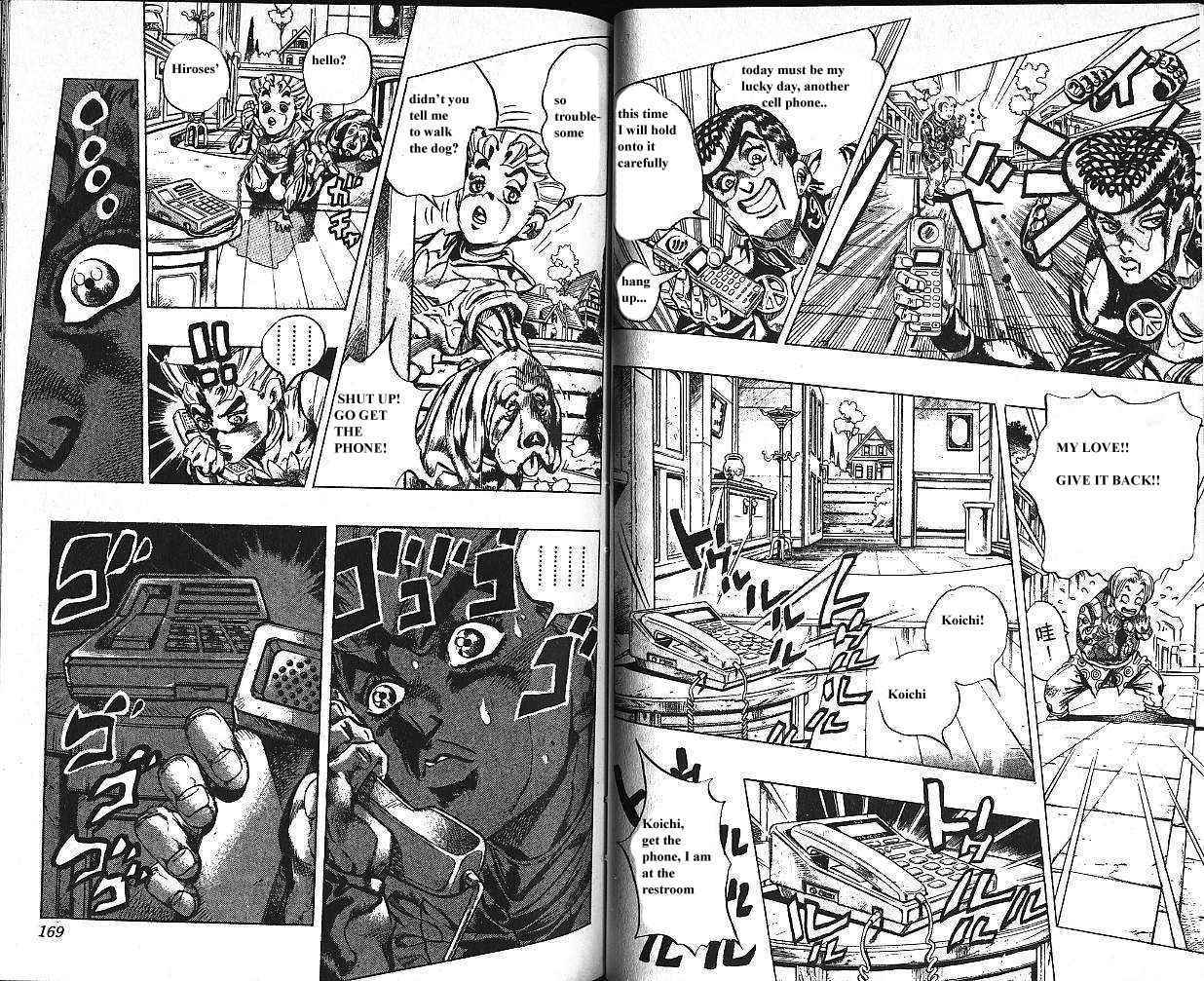
Manga Chapter of the Week: Diamond Is Not Crash Chapter 123 (Highway Star Part 5)
20th Century Boys, and Naoki Urasawa’s work in general, may borrow from popular culture quite a bit. However, he may be ill-matched by Hirohiko Araki, the author of long-runner Jojo’s Bizarre Adventure. If you know of JJBA, you may be aware of the fact that the author regularly copies the poses of fashion models and the everythings of the music industry. He also, midway through the series’ fourth installment, manages to parody the movie Speed. You know, the one where a large number of innocent commuters are stuck on a bus and if the bus goes slower than 50 miles per hour, it blows up? Just replace the bus with a motorcycle and the blowing up with crippling dessication, and you’ve got a pretty good idea of how this arc goes.
The difference? Comedy. Unlike Keanu Reeves, Josuke doesn’t have a radio link to his backup. So when he needs a phone, he resorts to sticky-fingers swiping it from a person who happened to need his to close a million-dollar deal:
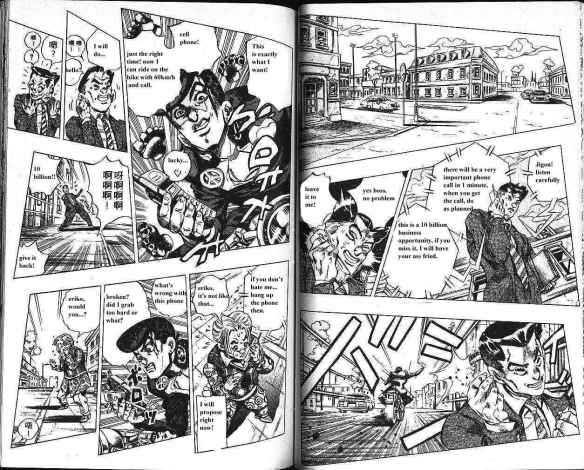
And it doesn’t even work, so he has to break up a marriage proposal too:
JJBA gets up to plenty of out-and-out ridiculous stuff, but these phone-grab scenes are some of the better examples of it nailing under-the-top comedy with the practiced finesse of an author who’d already been in this business a decade since a decade ago.
Summer 2013 Anime I Dropped: What, When, and Why
I’m a strong believer in the value of 20 minutes of time. Between work, the anime I do watch, the fact that I do play games on occasion, and my ongoing quest to find the next To Heart*, I’ve got plenty of venues to bank my time. There’s no real reason to keep watching a show, even if I’m enjoying it a little, if it doesn’t have at least an upside of being an 8/10 product. What follows is a list of Summer 2013 shows I dropped more or less because of their lack of realistic upside.
Manga Olympics for Bloggers: Apparently We Did Pretty Well
So a while back we participated in something called the Manga Olympics for Bloggers. What it amounted to was Sam and I writing up a storm of manga-specific posts about whatever struck our fancy in a give week. Turns out we did pretty swimmingly:
If you want to check out our MOB posts, they’re all conveniently under the Manga Olympics For Bloggers tag.
If you want to see who all participated (some very solid blogs were in the competition), check here.
If you started reading this blog because of the MOB and are feeling the lack of Manga-related material of late, well, mea culpa. But we do have a couple of things in the pipeline over the next several weeks.*
*Remember slaparounds? Pepperidge Farm remembers.
Animetics’ Drunken Vegas-Style Fall 2013 Anime Preview
It’s that time of quarter again! We’ve got a very interesting Fall season that’s coming out swinging this week, and there’s no better way to pay our respects to a season with potential deep sleepers like Tokyo Ravens and Gingitsune than to cavalierly turn them into race horses. We’re making mad bets on the Fall 2013 Season, Vegas-style!
Final Review: Gatchaman Crowds (10/10)
When anime franchises get rebooted, it’s fairly typical for the new staff to take it in a new direction and make something extra-special to celebrate the anniversary of a classic product. For examples of this done incredibly well, look no further than the 2012 Lupin III series or the 2009 Mazinger reboot. For the example of this done perfectly, take a gander at Kenji Nakamura’s take on the decades-old Gatchaman franchise and watch him take an already stellar skill set to a whole other level.
Meet the show with the year’s best villain, the year’s best protagonist, the year’s best two-person dialogue chain, the year’s most relevant-to-society themes, the year’s second-best opening (got Jaeger’d by the number one), the year’s best panda, and the best one-word BGM track in anime.
Meet Gatchaman Crowds.
First Reactions: Dangan Ronpa Episode 13 (End) and Quickie Scores (9/10)
Based on the formula it had followed thus far, I felt I had a pretty good idea of where Dangan Ronpa was going with its ending. I was wrong; the ending packed a genuine twist that flipped the premise on its head, tossing a bunch of huge endgame plusses for the show into the pot.
First Reactions: Free! Episode 12 (End) and Quickie Scores (8/10)
The two biggest unresolved plot threads of Free going into the final episode (Rin’s suspension from the relay team and the effects on his and Haru’s burgeoning rivalry) closely shadowed one of the show’s bigger strengths (its strong cast) but weren’t exactly playing to the show’s big strength; its kinetic visual sense. Given that, the direction the ending went wasn’t a huge shock. Though it was admittedly not one hundred percent something that I had anticipated, it still went down the right pipe.
First Reactions: WataMote Episode 12 (End) and Quickie Scores (7/10)
The ending for this series was very much its twelfth episode. It opened with a recap and ended with a loop to the beginning, showing a main character who made no real progress as a person. It wasn’t a conclusion that was difficult to predict, but it does again highlight the biggest weakness of a show that expects one character to carry the entire show on her back with only a bunch of situational humor as a sidekick. As it is, it’s a fun show, but by no means the best comedy of the year (or even the season).
Fun With Numbers: Adaptations of Award-Winning Manga and the Myth of Madhouse
It’s fairly frequent among people who have started to get interested in anime enough to start knowing things about the people who make it find themselves encountering the names of certain directors and studios over and over. Kasai Kenichi excels at college life stories. Hiroshi Nagahama was the bold visionary who directed Mushishi. Perhaps one of the more preeminent studios in that regard are Madhouse and Gonzo, the studios behind Death Note and Gankutsou, respectively. They can flash those series names on “from the studio that brought you” title cards of the trailer for anything else they make, despite the fact that Madhouse made the Marvel anime and Gonzo hasn’t been run by the people who made Gankutsuou since 2008. I’m here to make the case for why Madhouse’s reputation, along with a number of others, may be a bit overblown. It’s not that they’re not making awesome anime, but they are picking source material that gives them a lot of help.
This situation with directors can sometimes be a bit like that of the quarterback in American football; they get too much credit when things go well, and too much blame when things go wrong. In reality, lots of factors beyond the men at the top contribute to an anime’s success. I’m here today to take a look at one in particular; the pre-production choice of high-quality of source material. What follows is a look at anime adaptations of Shogakukan/Kodansha Award-Winning manga, including observations based on both their relative frequency over the years, their strength as a function of which studio makes them, and their performance in the marketplace.