Fun With Numbers: Null Hypotheses Predicting Fall 2013 Anime Sales

Note: The original version of this article incorrectly stated that there were 39 shows in the Autumn list, not 38. This has been corrected.

There’s a lot of gray area that can surround the performance of shows early on in a season, before hard stalker numbers roll in and make prior predictions fairly irrelevant with their impressive model. I’m interested in what some of these early and less-rigorous numbers can mean, both for disk sales and lower-cost indicators, and I’m slowly putting together a list of them for Fall 2013 to test against how the first volumes of disks actually sold, along with how big a sales boosts related print media got.* This post deals with very little of those, just outlines three dummy models against which all other indicators will be judged when I get around to it.

The first criterion for a bit of data having any real meaning is its ability to do better than guessing that is either random or very dumb, outperforming what is traditionally known as the null hypothesis. Let’s say you knew roughly what the anime market looked like in 2013, and were trying to build a model to try and guess how the 38 shows to on that list linked above would do. Let’s say you’re just interested in whether a show will sell more or less than 4000 copies, and you judge the success of your model by how well it’s able to peg which shows go over and which shows go under. For reference, 13 of the 38 had their first volume sell over 4000, so the “actual” over odds are about ~34%.**
Continue reading

Via Newtype USA: [inside] 4C (June 2003)

Along with an understanding of the broader context of the subject, the most vital ingredient to good anime coverage is a reliable source. So when US journalists actually interview people on the production side in Japan, it’s generally worth noting unless the interview consists entirely of fluff. This is the latest of what will hopefully be a couple more posts archiving articles from Newtype USA’s [inside] series of articles written by Amos Wong. This article on studio 4C includes President Eiko Tanaka talking about global markets and the technical aspect of continuous takes, Koji Morimoto talking about his work on the Animatrix and the producer who got him involved in the project, and Shinichiro Watanabe talking his issues with tight schedules.

Note: Pictures are scans of the article made on my crappy scanner, which cover the article text but not the entire page. They’re also in greyscale, because I’m interested in archiving interview text and color scans make the process more of a headache than it needs to be. Apologies for that. Scans after the jump, along with comments on the contents of the article.

Continue reading

Via Newtype USA: Mahiro Maeda Interviewed (June 2003)

Maeda Mahiro discusses his work on The Second Renaissance portion of the Animatrix, which took a draw-first, write-later approach to creation. It also (weirdly) contains the other half of the director-CG guy conversation started by Hiroshi Shirai in the [inside] Gonzo article. Also has one of the better quotes I’ve read so far; “That’s all anime is – something you do to kill time when school sucks.” (Talking not about the viewers, but how animators get to drawing and how then-modern technology had made it easier to create things with that lackadaisical, bored-during-class feel.)

Continue reading

Fun With Numbers: The West-Side All Stars

Something I stumbled onto a while a go that made me curious was a seemingly non-trivial connection between myanimelist popularity in the sales boosts of both novels and manga attached to a given anime, which led me to some speculation as to how different Western and Japanese fanbases’ preferences really are.

This time, I’m taking a look at a similar question; how many shows with high levels of Western popularity truly bomb in Japan? To answer this, I took the TV shows in the top 200 most popular on myanimelist, and excluded the ones attached to any series that averaged over 4000 in disk sales, or had a novel or manga chart in its first two release weeks at 20,000 copies or more. What remains is, theoretically, a list of the series which failed to catch on in Japan despite catching on in the West.* Data via myanimelist, someanithing, and the Japanese BD/DVD sales wiki. Note that I count the box releases as part of the disk average for pre-millenial series.

Continue reading

Ain’t no Absolutes: Bigger Numbers, Nonzero Numbers, and ‘Bad’ Opinions

I haven’t really done any kind of cleaning up of this blog since I started it a little over a year ago, so if you do a little digging, you can kind of tell that I originally intended for this to be more of a visuals-focused breakdown blog.* I started out the usual way, covering episodes week to week and churning out an occasional review. Obviously, that’s a bit different now. There are a couple of reasons why that approach has mostly gone out the window:

1. Episodic anime blogging is an extremely over-saturated medium. There are at least five blogs expressing any given opinion on any given show on any given week, with varying levels of prose. Most of them have existing followings. It’s not an efficient use of effort to take two years to try and build up a similar following to a commentator with a similar style, even if you do think you can write better.

1. a) Episodic anime blogging has a definite niche it can fill, but it has a number of shortcomings. For the discussion to advance past where it is right now, we don’t need more people talking about the same thing, we need to have people talking about different things.

2. I like to tinker around with spreadsheets. It’s just something I find fun. Too, looking at anime from different perspectives can lead to surprising insights on the medium itself that deepen my appreciation for just how much effort goes into it.

3. As a long-time worshipper at the churches of Neo Ranga and Futakoi Alternative, I’ve dealt with a lot of BS over the years to the effect of “it’s ridiculous to even say that show A is better than show B”. Beyond all the other neat things numbers can do, pretty much any metric available does a pretty good job of unsettling this debate. Some people use “number A is bigger than number B” arguments to assert that one show is better than another, but most numbers are actually telling a story of a world very far removed from such absolutes.

Continue reading

Via Newtype USA: Morio Asaka and Nanase Ohkawa on Chobits (March 2003)

This is a neat interview tidbit showing off some of the thought processes permeating earlier era Madhouse (the [inside] article on Madhouse, in another issue, elaborates a bit on their clamp connection). Morio Asaka talks about the blurred line between manga for girls and manga for boys (considering Chobits as a shojo manga even though it ran in a shonen magazine). Hidetoshi Abe mentions a post-credits revision to the second CCS movie’s ending that never made it in. Nanase Ohkawa talks about how she depicts male characters and the less intensive role (relative to CCS) she played in the anime’s production.

Continue reading

Via Newtype USA: [inside] Gonzo (March 2003)

Along with an understanding of the broader context of the subject, the most vital ingredient to good anime coverage is a reliable source. So when US journalists actually interview people on the production side in Japan, it’s generally worth noting unless the interview consists entirely of fluff. This is the latest of what will hopefully be a couple more posts archiving articles from Newtype USA’s [inside] series of articles written by Amos Wong. This one talks about what-if superstar studio gonzo, years before bankruptcy filings forced their biggest talents to split off into David Production and Studio Sanzigen.

Note: Pictures are scans of the article made on my crappy scanner, which cover the article text but not the entire page. They’re also in greyscale, because I’m interested in archiving interview text and color scans make the process more of a headache than it needs to be. Apologies for that. Scans after the jump, along with comments on the contents of the article.

Continue reading

Fun With Numbers: Pays to Shop Around

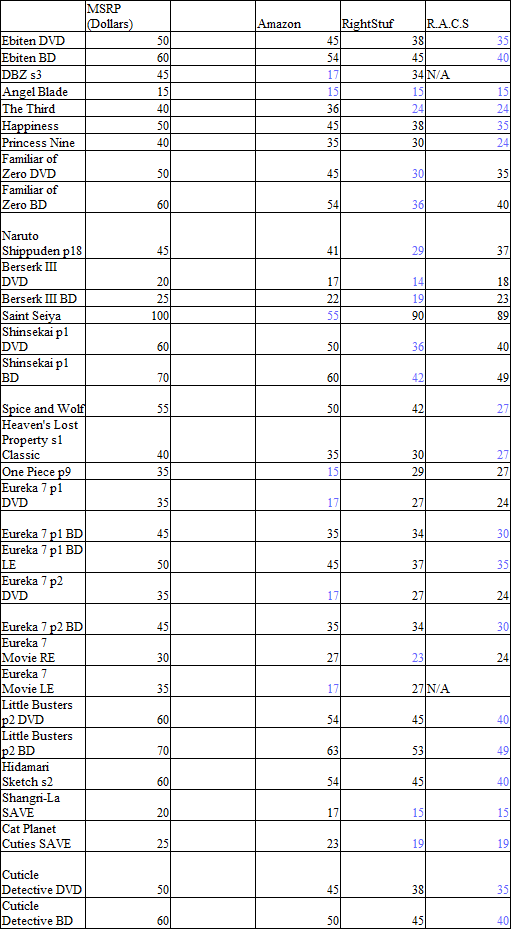
In my post-March piece on US amazon rankings, I noted there were other retailers that sold anime over the internet. I figured it was an important enough point that I took a look at the prices offered for the releases I’m tracking in April. Specifically, I took the MSRP for each of these 32 releases, and compared it to the actual prices offered at Amazon, Right Stuf, and Robert’s Anime Corner Store. Even a look limited to these three stores shows a pretty significant variation in which one offers the lowest price and how much (prices are in dollars and rounded up, lowest price in blue):

April-pricesNo one store has the consistent lowest price title sowed up. RACS seems to have be the bargain more of the time, and the amazon releases that are lower than the competition are much lower, but the relative price being offered really seems to depend on each release. Beyond helping me tweak my model and expectations for what US amazon can and can not be used for,* this list makes the millionth version of this point; if you’re going to shop for R1 releases, shop around.

*The rankings could still potentially be very indicative of the relative strength of similarly priced series, as stuff like shipping and service can cause people to prefer certain retailers. It comes down to whether amazon popularity is indicative of popularity elsewhere or not. Either way, it’s probably smart to expect Sentai releases with their lowest prices offered elsewhere to be underestimated by an amazon-only model.

Via Newtype USA: [inside] Bones (February 2003)

Along with an understanding of the broader context of the subject, the most vital ingredient to good anime coverage is a reliable source. So when US journalists actually interview people on the production side in Japan, it’s generally worth noting unless the interview consists entirely of fluff. This is the latest of what will hopefully be a couple more posts archiving articles from Newtype USA’s [inside] series of articles written by Amos Wong. In this one (the first chronologically in the series) President Masahiko Minami talks about the studio’s origins and namesake, Hiroshi Ousaka talks about research trips to Morocco, and Toshihiro Kawamoto talks about using digital effects to produce more effective POV shots.

Note: Pictures are scans of the article made on my crappy scanner, which cover the article text but not the entire page. They’re also in greyscale, because I’m interested in archiving interview text and color scans make the process more of a headache than it needs to be. Apologies for that. Scans after the jump, along with comments on the contents of the article.

Continue reading