A little over a week ago, I wrote about how seemingly improbable this season’s Yozakura Quartet sequel was. It was anomaly, lacking any of the traditional indicators (profitable disc sales, TV ratings in excess of 3%, visible boost in the sales totals of the manga). Or at least it was until you look at the unique way in which the most recent series of OADs was marketed. As it turns out, the Yozakura Quartet OADs, though failing to chart, were very probably profitable. The makers made their dues by exploiting a bit of a backdoor in the niche anime industry: piggybacking on the much larger manga market.
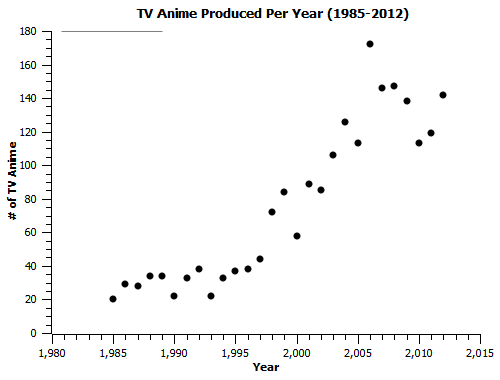
Much has often been made of how the anime industry has evolved over the years. Whenever this is pointed out, it’s usually framed in the form of some criticism; the prevailing artstyle has changed (somewhat true, but largely irrelevant), the amount of ecchi/harem anime has increased (true, though they are now less profitable than other genres), awesome manly anime don’t get made like they used to be (false), artsy anime never sell these days (false). One of the bigger indicators of sour grapes on the part of people offering such criticisms is the assertion that it wasn’t always this way, that whatever change they point out in modern anime is a symptom of the declining health of a sickly industry doomed to implode upon itself.* In reality, that implosion kind of already happened back in 2007; anime makers overproduced and had a bad year, and so made an industry-wide decision to cut back on the number of anime being made yearly. The result? Anime’s still here; the worst that happened was that 2010-2011 saw production drop back to 2003 levels, and 2012 saw an increase in production equivalent to the 2009-2010 dropoff:
Just because the industry’s making lots of stuff doesn’t mean it’s all selling well, though. That’s another point worth examining, because it turns out anime nowadays is better at churning out hits than it’s been at any point in the past.
So the first episode of Tokyo Ravens was really solid. I’ll have a better idea of where it actually is as a show in 3 or 4 weeks, but right now, it’s clear to me it’s going to be fighting Kyoukai no Kanata for the seasonal belt of best show of the season with a mid-major battle premise.* And similar to KnK, it also packs the OP that launched a thousand ships; one that teases gobs of potential while looking really freaking cool. I do have some comments on it, but I recommend just watching it first. Make your next 90 seconds a fine bunch:
Among the really interesting things this OP does is that the title comes in 40 seconds in, and isn’t punctuated by the up-tempo swinging of the song. This is something 95% of anime OPs don’t do; usually there’s a matchup between the title card and music for easy symmetry. But here they’re cracking that convention for effect, keeping the music relatively steady while bookending the title card with two strong visual moments (the sliding splitscreen image of the cast and the MC punching the screen), and it definite gives the OP a bold, ambitious feel.
But really, it does so many slick things, including the TVs-within-TVs imagery that leads to the MC punching the screen halfway in, the hovering/sliding credits, and the glasses that turn into a moon on fire. It only sometimes relies on super-framerate animation, also mixing in rapidly shifting camera angles and doing the Utena thing where it drops something ostensibly important and obviously cool-looking for half a second before flashing away. The whole sequence from 36 seconds to 75 seconds is so jam-packed with stuff like this that it’s near-impossible to break away from. The content it’s teasing intrigues me as much as the OP itself, but I’ll have more time to write about that as it actualizes its potential over the rest of October.
*Not in sales or overall popularity, certainly, but when I want to write about numbers I’ll write about numbers. My stance on them is that they correlate with a show’s quality and they’re really important when it comes to understanding trends in the type and number of anime produced, but they only correlate with moderate strength against a show’s true entertainment value. Advertising and the fact that some people easily dismiss shows on superficial things like artstyle play into that, but they’re far from the only reasons.
I’m pretty ok with Yozakura Quartet getting its second crack at TV anime this season. It’s a series with a lot of potential; if nothing else, the power to produce machine guns out of thin air that fire when you say bang-bang is a unique one. But the manga is a repetitive criminally slow-paced monthly, the first anime was a hopelessly melodramatic show that failed to top 1000 in average volume sales, and the second, OVA-based anime was a thinly-veiled sakuga showcase. It’s a series that definitely could get over the hump, and clearly people care enough to keep trying.
But why? I’ve got no financial explanation. Given that its season 1 sales were less than borderline and the OVA failed to chart, the fact that it’s still getting anime is impressive and puts it in a very small circle. It’s not that the new series has been promoting the manga like a Blue Exorcist or an Inu x Boku SS either; the 7th volume in 2009 and the 13th volume in 2013 logged near-identical 70,000 volume sales totals. The most popular installment on myanimelist is only about 800th in popularity, so I doubt it’s even a max-money license show. It’s probably one of the 5 or 10 least explicable sequels to be made in the past 10 years. If I ever find out an definitive answer to this question, even if that answer is “passion project funded by the mangaka or the studio”, expect that to be its own article. But right now, there really isn’t one.
So a while back we participated in something called the Manga Olympics for Bloggers. What it amounted to was Sam and I writing up a storm of manga-specific posts about whatever struck our fancy in a give week. Turns out we did pretty swimmingly:
If you want to see who all participated (some very solid blogs were in the competition), check here.
If you started reading this blog because of the MOB and are feeling the lack of Manga-related material of late, well, mea culpa. But we do have a couple of things in the pipeline over the next several weeks.*
It’s fairly frequent among people who have started to get interested in anime enough to start knowing things about the people who make it find themselves encountering the names of certain directors and studios over and over. Kasai Kenichi excels at college life stories. Hiroshi Nagahama was the bold visionary who directed Mushishi. Perhaps one of the more preeminent studios in that regard are Madhouse and Gonzo, the studios behind Death Note and Gankutsou, respectively. They can flash those series names on “from the studio that brought you” title cards of the trailer for anything else they make, despite the fact that Madhouse made the Marvel anime and Gonzo hasn’t been run by the people who made Gankutsuou since 2008. I’m here to make the case for why Madhouse’s reputation, along with a number of others, may be a bit overblown. It’s not that they’re not making awesome anime, but they are picking source material that gives them a lot of help.
This situation with directors can sometimes be a bit like that of the quarterback in American football; they get too much credit when things go well, and too much blame when things go wrong. In reality, lots of factors beyond the men at the top contribute to an anime’s success. I’m here today to take a look at one in particular; the pre-production choice of high-quality of source material. What follows is a look at anime adaptations of Shogakukan/Kodansha Award-Winning manga, including observations based on both their relative frequency over the years, their strength as a function of which studio makes them, and their performance in the marketplace.
This past year, viz media pulled off a first for the non-Japan manga industry. I’m referring to Shonen Jump Alpha, a digital “magazine” offering same-week release of the chapters of some 11 Weekly Shonen Jump manga. It’s pretty cool, and at 26$/year for 48 issues (and a buck per back issue), it’s not a totally unreasonable subscription fee. But that specific business model, one of same-week releases for official translations, is unfortunately not something that’s likely to be transferable to the majority of manga. Especially seinen and josei series with smaller fanbases. If you’ve ever wondered if the manga translation industry will catch up to where the anime industry is now with simulcasts, this article discusses the depressing reality of the situation and why such an outcome is relatively unlikely.
I just spent the past week and a half or so writing abouthow the anime industryresponded to various changes in technology over the years. While I was writing those articles, I noticed that the changes occurred roughly every five years or so, and, going by that observation, we were “due” for another change soon. While the notion of things being “due” in general is a fairly foolish one, it did serve as the spark for a brainstorm about where that change might eventually come from. Eventually, I came across two possibilities that I felt were worth talking about: Web Anime and 3DCG anime.
Every so often, the anime industry goes through a metamorphosis and comes out on the other side looking a bit different. In parts one and two of this series, I covered how late-night TV timeslots altered the landscape of how adult-oriented anime was produced and how the switch to digital painting affected both the abundance of shows made and the predominant artstyle. Unless you believe that we’re in the middle of the beginning of another one right now with Net-only full-season shows or 3DCG shows,* the most recent major sea change to beset industry was the introduction of Blu-Rays, which came into the field in late 2006 and were making up the majority of sales for most adult-oriented anime by 2009.
Welcome to part 2 of this series on how different changes in production and distribution methods affected anime over the years. Last time, I talked about how late-night TV anime came to be the norm for the industry, bringing with it free advertising and the ability to pursue more adult storylines in longer-form media than OVAs (the previously preferred form of adult-oriented anime). The impact of that still plays into today’s topic, though it’s not the subject. This time, the focus is on a pair of subsequent changes that led to still-further increases in production (the second big jump on the graph below).
The first half of the 2000s saw 2 meaningful changes affecting the anime industry. First, studios switched over from old-school cel painting to a digital paint process, reducing production costs and causing a subtle shift in both artstyle and visual presentation. Second, people started buying DVDs over VHS tapes, further reducing production costs (Incidentally DVDs being cheaper to produce than VHS tapes was a key cause of the 2007-2008 WGA strike in America).

 Animetics