Fun With Numbers: Explaining Why Unpopular Anime Get Sequels

If there’s an inverse situation to not seeing a sequel to something you liked that you know was really popular, it’s getting a sequel when you in no way expected one. Disc sales are a pretty good indicator of when something is commercially viable enough to get a second season, but they aren’t the only factor playing in. There are a couple of consistent ways that anime with non-profitable sales wind up with more than one season, and that’s what I’m looking at today. Examination of the ones that did sequel reveals a rather unsurprisingly grim prognosis for fans of old, poorly-selling shows hoping that they’ll get more.

Continue reading

Fun With Numbers: Explaining Why Popular Anime Don’t Get Sequels

There are few things more frustrating than loving an anime that has room to grow as a story, but never gets beyond one season of material. It’s arguably even more of an irritance when you know the second season would easily pay for itself. Fortunately, it’s very rare for popular anime to not get sequels (happens only about 20% of the time), and there are ways to predict which ones those will be. I like to think knowing softens the heartbreak.

Continue reading

First Reactions: Tokyo Ravens Episode 2

I’m a bit less sure that I know what I’ve got with this show after two episodes; the second one mixed in a lot of of new elements, some more surprising than others. It’s still introducing of its story elements without getting infected with proper noun disease, which is a plus. Still looking forward to it, but a lot of what I’m assuming would develop into plot elements is still covered in question marks.

Continue reading

First Reactions: Arpeggio of Blue Steel Episode 2

The first episode of Arpeggio was very much an introductory one a few very high-octane minutes followed by an origin story for the main characters and their supertech submarine. That expositional phase of the series apparently mostly ended last week, as this week’s episode was what I would guess will be the meat of the series; naval combat that was as snazzily animated as it was thought out and tense.

Arpeggio-2-1

Episode 1 also brought some predictable backlash, with many commentators criticizing the full-3DCG animation style. Personally, I have the same stance on it that I had on Kaiji (loved it), Aku no Hana (not a huge fan), the cars in Initial D (Eurobeat), and many other shows with atypical artstyle. Choosing to be different means nothing, it really comes down to how well it gets executed. So far, the show’s been doing a more than respectable job of that. Meanwhile, the market continues to speak for itself, as the BD for the show’s first volume is currently the 8th-most preordered one of the season and rising in spite of a significantly shorter solicitation time.*

Continue reading

Fun With Numbers: Explaining Yozakura Quartet’s Second Season

A little over a week ago, I wrote about how seemingly improbable this season’s Yozakura Quartet sequel was. It was anomaly, lacking any of the traditional indicators (profitable disc sales, TV ratings in excess of 3%, visible boost in the sales totals of the manga). Or at least it was until you look at the unique way in which the most recent series of OADs was marketed. As it turns out, the Yozakura Quartet OADs, though failing to chart, were very probably profitable. The makers made their dues by exploiting a bit of a backdoor in the niche anime industry: piggybacking on the much larger manga market.

Continue reading

Fun With Numbers: The Anime Industry Is Demonstrably Healthy (And Not Dying)

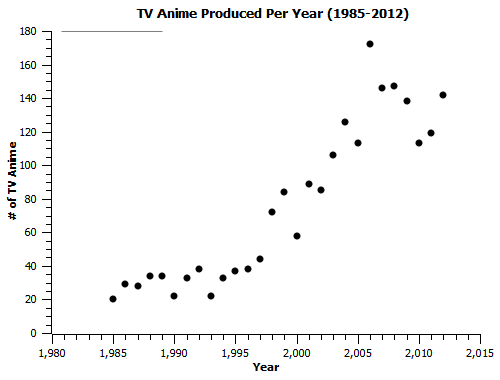
Much has often been made of how the anime industry has evolved over the years. Whenever this is pointed out, it’s usually framed in the form of some criticism; the prevailing artstyle has changed (somewhat true, but largely irrelevant), the amount of ecchi/harem anime has increased (true, though they are now less profitable than other genres), awesome manly anime don’t get made like they used to be (false), artsy anime never sell these days (false). One of the bigger indicators of sour grapes on the part of people offering such criticisms is the assertion that it wasn’t always this way, that whatever change they point out in modern anime is a symptom of the declining health of a sickly industry doomed to implode upon itself.* In reality, that implosion kind of already happened back in 2007; anime makers overproduced and had a bad year, and so made an industry-wide decision to cut back on the number of anime being made yearly. The result? Anime’s still here; the worst that happened was that 2010-2011 saw production drop back to 2003 levels, and 2012 saw an increase in production equivalent to the 2009-2010 dropoff:

FWN-TVan-1Just because the industry’s making lots of stuff doesn’t mean it’s all selling well, though. That’s another point worth examining, because it turns out anime nowadays is better at churning out hits than it’s been at any point in the past.

Continue reading

First Reactions: Outbreak Company Episode 2

Even though Thursday isn’t crowded, I’m on enough of a mid-major kick that Outbreak Company seems like a fun blog target right now. Golden Time is somewhat lacking in pizazz, though definitely a keeper, and Kill La Kill isn’t packing much more than a hollow imitation of TTGL/PSG after 2 episodes. Of the shows that I’m still following, Outbreak Company is only behind Tokyo Ravens right now in terms of how much it’s been able to surprise me, so I feel like it’s worth talking about until it proves me otherwise.

The fundamental appeal of Outbreak Company is one with a pretty good chance of striking a chord with anyone who’s ever had to get a friend started on anime, or convince people it wasn’t all one cliched genre. Thanks to the fact that it’s executing with minimal forced fanservice, what might become the saving grace of a lesser series becomes this show’s cold-steel core; watching a smart fanboy import culture with the full faith and credit of the Japanese government behind him. In essence, it’s a show that focuses on all the cool things happening in manga and anime (more manga so far) as a whole, respecting the power of both everlasting classics and modern-day megahits. For as low as I was on the show going in, I have to say it’s been executing its premise in more or less the best way possible.

Continue reading

First Reactions: Kyoukai no Kanata Episode 2

I can’t help myself. Coppelion may have had the better high-concept first episode, but Kyoukai no Kanata presented the higher ceiling. That and the 100% odds I have of blogging Tokyo Ravens at this point gives me the chance to blog two good mid-major battle series for the first time since opening the blog. No way I’m passing that opportunity up.

Last week, I did have two semi-serious complaints about this show – the dialogue was a bit canned, and the camerawork was a bit uninspired when the action wasn’t running at 100 klicks per hour. The show’s pluses (aforementioned action and the male lead’s Yokoshima Tadao/Taiga Kuzumi combat style) were still more than enough to make it one of my favorite first episodes of the season. This episode’s combat scenes continued to be a great ranging experience, but I wasn’t really expecting it to get the dialogue into a rhythm as fast as it did.

Continue reading

Sell Me in 20 Minutes: Samurai Flamenco and Galilei Donna

Minus Yowamushi Pedal (cheat to win-strong is still way too fresh in my head for me to care about cycling) and Pupa (airs who-knows-when), the last pair of shows to air this season are running in the noitaminA timeslot, the first pair of original series they’ve run in over a year. Shows on noitaminA are still cause for moderate excitement, but the brand’s taken a bit of a dip in recent years, so I approached the day’s fare with cautious optimism.

Continue reading

Sell Me in 20 Minutes: My Mental Choices

Only one new show today, and it didn’t take too long to form an opinion on. The presentation of My Mental Choices was of the very dull kind; not outright lazy in the way BlazBlue was lazy, but in the circa 2005 sense when art was getting polished up but nobody making the show cared about anything but their next paycheck. And then there were parts that were just outright sloppy, like the insert song from out of nowhere during the bullshit science bit that went on for way too long (whenever you have 3 verbal audio tracks competing for the available audio space without a press scrum taking place on-screen, somebody screwed up big). Also, the point of the comedy was poorly established and made it hard to feel strongly either way about the main character. One one hand, he was doing things too reprehensible to like, but it’s hard to hate him because it’s very technically not his fault. It’s tough not to see this as an excuse plot to have splatter fanservice all across the screen. The premise was less of a problem than the ass-awful presentation, truth be told, but nothing that really promises more than a giant pile of mud in this one. Dropped in the strongest possible terms.