First Reactions: Outbreak Company Episode 2

Even though Thursday isn’t crowded, I’m on enough of a mid-major kick that Outbreak Company seems like a fun blog target right now. Golden Time is somewhat lacking in pizazz, though definitely a keeper, and Kill La Kill isn’t packing much more than a hollow imitation of TTGL/PSG after 2 episodes. Of the shows that I’m still following, Outbreak Company is only behind Tokyo Ravens right now in terms of how much it’s been able to surprise me, so I feel like it’s worth talking about until it proves me otherwise.

The fundamental appeal of Outbreak Company is one with a pretty good chance of striking a chord with anyone who’s ever had to get a friend started on anime, or convince people it wasn’t all one cliched genre. Thanks to the fact that it’s executing with minimal forced fanservice, what might become the saving grace of a lesser series becomes this show’s cold-steel core; watching a smart fanboy import culture with the full faith and credit of the Japanese government behind him. In essence, it’s a show that focuses on all the cool things happening in manga and anime (more manga so far) as a whole, respecting the power of both everlasting classics and modern-day megahits. For as low as I was on the show going in, I have to say it’s been executing its premise in more or less the best way possible.

Continue reading

Manga Chapter of the Week: One Outs Chapter 141 (Fissure)

Shinobu Kaitani’s One Outs, the story of ace player/owner of the Saitama Lycaons, Tokuchi Toua, is without question the best in an increasingly long list of baseball series I have read to date. It’s set in a professional level, and much like Giant Killing, it features everything that makes pro sports so interesting; contract disputes, arcs of victory and defeat over a long season, and players who are all at least nominally in the top 5% talent-wise (even if the Central and Pacific Leagues are kind of a few miles below the AL and NL). The difference between the two is that where Giant Killing chooses to attack pro sports with realism, One Outs chooses  to fight with showmanship. Toua forgoes all the traditional principles of baseball, getting opponents out at a historic rate with only a slowball/slider and a heaping helping of quick wit in his arsenal. Eventually, a combination of his dominance on the plate and his harsh but performance-based contract makes him filthy rich, and puts him in position to buy out the team his contract bankrupted. And that’s where the real fun, him leading his lackluster team to the pennant, starts. The chapter in question is a part of the Lycaons’ quest for the pennant, as they duke it out with a hilariously top-heavy first-place Mariners team.

Continue reading

Manga Chapter of the Week: Diamond Is Not Crash Chapter 123 (Highway Star Part 5)

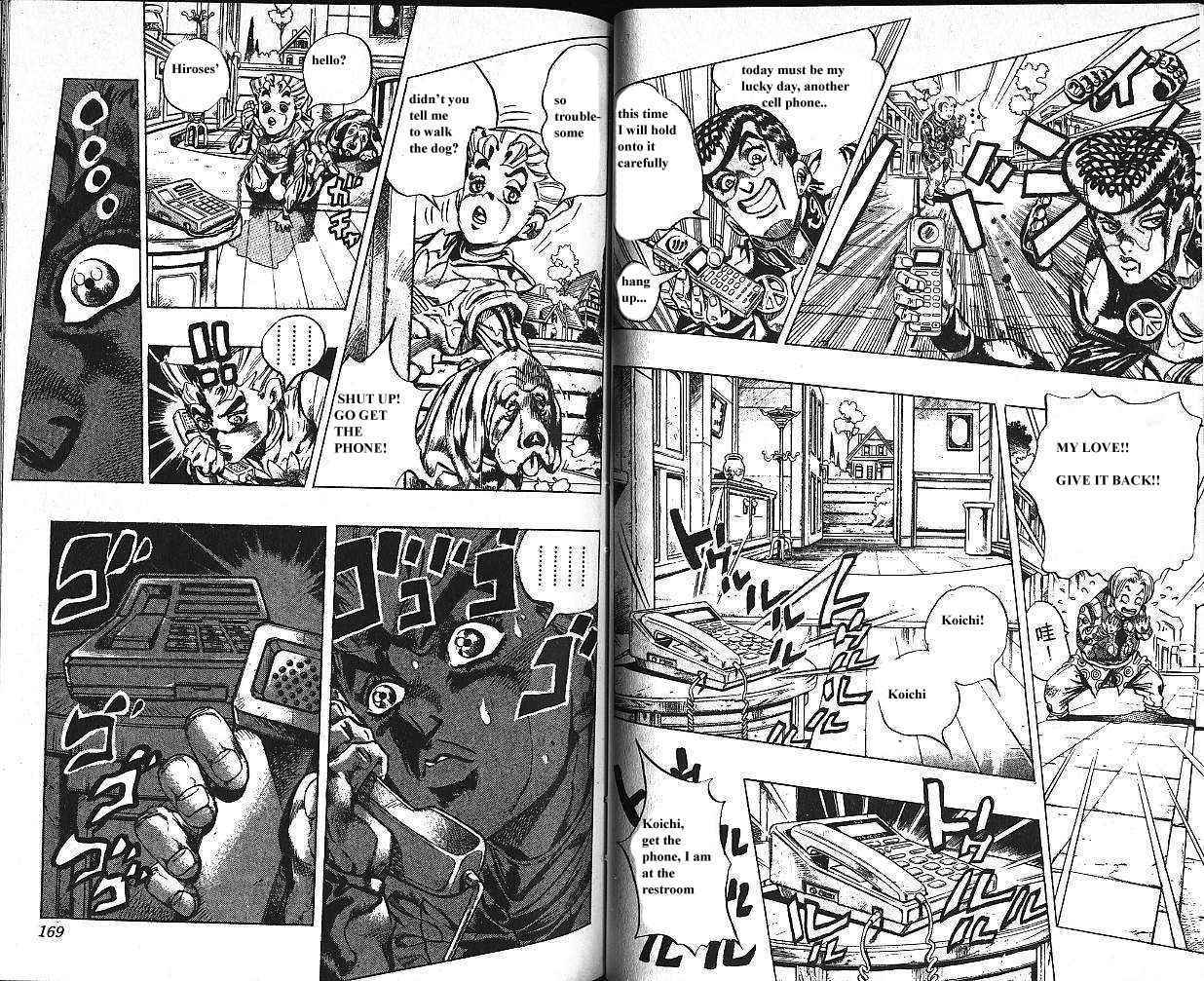
20th Century Boys, and Naoki Urasawa’s work in general, may borrow from popular culture quite a bit. However, he may be ill-matched by Hirohiko Araki, the author of long-runner Jojo’s Bizarre Adventure. If you know of JJBA, you may be aware of the fact that the author regularly copies the poses of fashion models and the everythings of the music industry. He also, midway through the series’ fourth installment, manages to parody the movie Speed. You know, the one where a large number of innocent commuters are stuck on a bus and if the bus goes slower than 50 miles per hour, it blows up? Just replace the bus with a motorcycle and the blowing up with crippling dessication, and you’ve got a pretty good idea of how this arc goes.

The difference? Comedy. Unlike Keanu Reeves, Josuke doesn’t have a radio link to his backup. So when he needs a phone, he resorts to sticky-fingers swiping it from a person who happened to need his to close a million-dollar deal:

JJBA-pt4-c123-1

And it doesn’t even work, so he has to break up a marriage proposal too:

JJBA-pt4-c123-2

JJBA gets up to plenty of out-and-out ridiculous stuff, but these phone-grab scenes are some of the better examples of it nailing under-the-top comedy with the practiced finesse of an author who’d already been in this business a decade since a decade ago.

Manga Olympics for Bloggers: Apparently We Did Pretty Well

So a while back we participated in something called the Manga Olympics for Bloggers. What it amounted to was Sam and I writing up a storm of manga-specific posts about whatever struck our fancy in a give week. Turns out we did pretty swimmingly:

MOB for animetics 3If you want to check out our MOB posts, they’re all conveniently under the Manga Olympics For Bloggers tag.

If you want to see who all participated (some very solid blogs were in the competition), check here.

If you started reading this blog because of the MOB and are feeling the lack of Manga-related material of late, well, mea culpa. But we do have a couple of things in the pipeline over the next several weeks.*

*Remember slaparounds? Pepperidge Farm remembers.

Fun With Numbers: Adaptations of Award-Winning Manga and the Myth of Madhouse

It’s fairly frequent among people who have started to get interested in anime enough to start knowing things about the people who make it find themselves encountering the names of certain directors and studios over and over. Kasai Kenichi excels at college life stories. Hiroshi Nagahama was the bold visionary who directed Mushishi. Perhaps one of the more preeminent studios in that regard are Madhouse and Gonzo, the studios behind Death Note and Gankutsou, respectively. They can flash those series names on “from the studio that brought you” title cards of the trailer for anything else they make, despite the fact that Madhouse made the Marvel anime and Gonzo hasn’t been run by the people who made Gankutsuou since 2008. I’m here to make the case for why Madhouse’s reputation, along with a number of others, may be a bit overblown. It’s not that they’re not making awesome anime, but they are picking source material that gives them a lot of help.

This situation with directors can sometimes be a bit like that of the quarterback in American football; they get too much credit when things go well, and too much blame when things go wrong. In reality, lots of factors beyond the men at the top contribute to an anime’s success. I’m here today to take a look at one in particular; the pre-production choice of high-quality of source material. What follows is a look at anime adaptations of Shogakukan/Kodansha Award-Winning manga, including observations based on both their relative frequency over the years, their strength as a function of which studio makes them, and their performance in the marketplace.

Continue reading

Manga Chapter of the Week: Hajime no Ippo Chapter 1029 (Arrival of a New Era)

There’s no doubt Hajime no Ippo, between its length, consistent sales figures, and zesty-rich iconic cast that delivered an amazing quality of story. But that story’s quality level is averaged over a long run, and recently the manga’s been hampered by some baggage; blatantly unrealistic fights, predictable endings to said fights, and some questionable arc decisions.It got so bad that I didn’t trust George Morikawa to fix it, which is why I dropped the series for over a year, but fix it he did. Chapter 1029, making a centerpiece of the defeat of the previously stupidly invincible Itagaki Manabu, is just the latest in a long line of franchise-correcting tight corners.

Continue reading

Fun With Numbers: Scarce Demand for Simulmanga

This past year, viz media pulled off a first for the non-Japan manga industry. I’m referring to Shonen Jump Alpha, a digital “magazine” offering same-week release of the chapters of some 11 Weekly Shonen Jump manga. It’s pretty cool, and at 26$/year for 48 issues (and a buck per back issue), it’s not a totally unreasonable subscription fee. But that specific business model, one of same-week releases for official translations, is unfortunately not something that’s likely to be transferable to the majority of manga. Especially seinen and josei series with smaller fanbases. If you’ve ever wondered if the manga translation industry will catch up to where the anime industry is now with simulcasts, this article discusses the depressing reality of the situation and why such an outcome is relatively unlikely.

Continue reading

Manga Chapter of the Week: Diamond is not Crash Chapter 30 (Let’s Go Out for Italian, Part 3)

I’m a sucker for a good cooking manga. I’m even more a sucker for it when it’s pulled out of nowhere in a superpowered battle series and yet feels totally welcome. It’s why Toriko is so balls-on amazing under normal circumstances. And why it’s so lackluster now, when nary a character has had their muscles restored by a delicious cake in over half a year. So I’ve been satisfying my hunger* with a number of manga, most notably the raws of an almost-finished Akagi and the charmingly-amateurish classic Duwang scans of Jojo’s Bizarre Adventure. This week’s featured chapter comes from the latter, not for the unintentional comedy, but because this spaghetti looks really, really good:23_10_24_2011_21_54_23

Continue reading

Manga Chapter of the Week: Giant Killing Chapter 139

Masaya Tsunamoto’s 2010 KMA-winning professional soccer manga Giant Killing is a very unique piece of material. Unlike most sports manga, it follows the development of a team in a professional league over the course of a rather realistic season, where losses and draws are as common as wins. It also stands out for putting the focus of the narrative not just on the athletes and the disgraced ex-player returning from England to coach the team, but also on the team’s fans (from the 40-something fair weather fans who don’t travel well to the 20-something hooligans who cheer loud and riot louder) and its front office (who have to deal with bad press when things aren’t going so well).

Indeed, the story of the manga opens with staff from the front office on a trip to England, trying to lure the team’s former ace Tatsumi back to Japan as the team’s manager. And the very next story deals with the negative light in which the fans view Tatsumi, who quit the team at the prime of his career. Only after these two dynamics are introduced does the manga start playing any kind of soccer. It’s a three-pronged approach to soccer which gives the reader a much deeper understanding of the layers of culture within professional sports.

The series has recently been in the middle of an extensive gaiden arc, telling the real story of why Tatsumi left the team. It turns out that decision was less selfishness and more the fault of a system that forced him, albeit somewhat willingly, to the breaking point.

Continue reading

Manga Chapter of the Week: Steel Ball Run Chapter 46 (Promised Land: Sugar Mountain 2)

This weekend, I sunk my teeth into the seventh installment of the Jojo’s Bizarre Adventure series, cheating a little bit as far as part order order goes.* It ended up being a very worthwhile decision, as I found the series contained bite after juicy bite of ridiculous (but not incomprehensible) content. It’s got everything from non-superpowered horse racing to dinosaur fights to spy-novel style infiltration scenes. It didn’t take me long to plow through the whole story, which integrates both a continental horserace and an epic bodyhunt. SBR is far from a perfect series,** but it’s got mad merits on writing and the way it uses full-page spreads to lay out a scene.

My favorite chapter of the series deals with a comically complex Stand/superpower that’s got abilities halfway between the Golden Axe fable and Leprechaun Gold. It works in the following way: the stand’s owner, Sugar Mountain, offers to return something that a person dropped, but offers both the thing dropped and a ridiculously more valuable version of the same (say you drop an Oreo cookie, she’ll offer you that or a two-pound cheesecake). If one answers honestly as to which they dropped, they get the works. They then have to use up both of those items in fair trades (i.e. they can’t just give them away for free) by sunset the day they receive them. If they fail to do both of those things, they turn into trees like so:

SBR-46-1

Yeah, it’s a little weird

So that’s the general setup, introduced in the chapter prior to this one. Also in the prior chapter, protagonists Gyro and Johnny managed to finagle a couple of necessary body parts off of Sugar Mountain by correctly negotiating the Golden Axe rule of her stand. Beyond the body parts, they’ve acquired a diamond, gold ore, a fancy watch, and $50,000 in cold hard cash. This chapter follows them trying to avoid becoming petrified wood by burning through their Leprechaun Gold via fair trade. All while being chased by a bunch of government assassins. If you think that sounds like the basis of a hilarious heist comedy’s third act, well, you’d be more or less on the money.

Continue reading