Fun With Numbers: Nico Stream Rankings Predicting Summer 2013 Disk Over/Unders

Quick recap: I’m taking a look at various no-cost indicators of popularity for anime and their related goods. First, I’m checking how well they correspond to disk sales by checking whether different applications of that statistic beat the null “every v1 will sell less than 4000 disks” accuracy criterion for a given season (66% for Fall, 59% for Summer). Later I’ll check how well these indicators corresponded to boosts in manga/LN source popularity (for works that were originally LN/manga), to contrast their predictive abilities at both high-cost and low-cost levels of interest.

Nico stream rankings are often discussed in the context of early-season indicators of disk sales, and my analysis of the Fall 2013 shows for which those numbers were available did show a bunch of different versions of the data proving more accurate than the null hypothesis. Adding another season should help control for any peculiarities with the Fall season.

The accuracy rates for the top 5/10/15 models using only the 25 series Summer series with Nico stream data available, split into 3 averaged samples corresponding to the beginning, middle, and end (labeled 9-12, but occasionally 9-13 or 9-10) of the series. The individual rank data was compiled here, and the sorted version can be found here. The bare-bones summary of the results is below (green means an accuracy greater than that of the null hypothesis).

Note: the chart format groups by period, rather than by metric, as the Fall chart did.

Summer2013-nico-compThat’s a lot of green, corresponding to a fairly useful indicator. While there are notably some top-tier performances that failed to lead to disk sales (Watamote was top 5 in half the metrics, top 10 in all of them), the general results point to an indicator that can be fairly discussed early on as a broad-basis indicator of disk-buyer popularity.

Peculiarly, the max rating percentage becomes a less accurate indicator for the later periods. This appears to be due to the rise of specific shows (Genshiken Nidaime, Rozen Maiden’s reboot) that lost viewers while maintaining the number of viewers giving the max scores; most likely, many of the people who had middling opinions of them checked out after the first month, leading to somewhat inflated scores.


Fun With Numbers: Normalized Google Traffic Predicting the Summer 2013 Disk Over/Unders

Quick recap: I’m taking a look at various no-cost indicators of popularity for anime and their related goods. First, I’m checking how well they correspond to disk sales by checking whether different applications of that statistic beat the null “every v1 will sell less than 4000 disks” accuracy criterion for a given season (66% for Fall, 59% for Summer). Later I’ll check how well these indicators corresponded to boosts in manga/LN source popularity (for works that were originally LN/manga), to contrast their predictive abilities at both high-cost and low-cost levels of interest.

Google traffic offers a neat and fairly intuitive, if sometimes difficult to standardize, way of checking the popularity of shows, but it needs to be tested as much as any other stat. If you want to see the google data this check is based off of, it’s here. The doc where the checks were calculated is here, and the checks themselves are summarized below (numbers beating the null hypothesis shown in green):

Summer2013-google-comp

While top 5 rankings bested the null hypotheses across the board, other more inclusive checks took a little while longer to become precise. It’s possible that that’s just some imperfections of the indicator showing, or that Summer saw more fluctuation in interest as the season wore on than Fall did.

Fun With Numbers: Torne DVR Rankings Predicting the Summer 2013 Disk Over/Unders

Quick recap: I’m taking a look at various no-cost indicators of popularity for anime and their related goods. First, I’m checking how well they correspond to disk sales by checking whether different applications of that statistic beat the null “every v1 will sell less than 4000 disks” accuracy criterion for a given season (66% for Fall, 59% for Summer). Later I’ll check how well these indicators corresponded to boosts in manga/LN source popularity (for works that were originally LN/manga), to contrast their predictive abilities at both high-cost and low-cost levels of interest.

I’ve already looked at the torne DVR ranks for Fall, now I’m doing the same for summer, where the accuracy of null hypothesis test is 59%. The results are listed below, with the lists and detailed breakdowns here. Less than 15 shows made the rankings for August and September, so I didn’t do a top 15 check for those two.

Summer2013-torne-compDespite some changes in what the top 5/10 were, none of these selection criteria did better than the null hypothesis, which is a pretty bleak sign for the rankings as a disk-sales picker given its middling Fall results (though obviously the jury’s still out on manga/LN boosts).

Fun With Numbers: Normalized Google Traffic for Summer 2013 Anime

I’m going to be doing the over/under 4k v1 data for Summer 2013 before I take a look at how the various indicators stacked up against source material boosts for manga/LN adaptations. The rationale there is that it’d be good to have at least two independent sets of data to crunch before I start getting tempted to draw too-sweeping conclusions from one set that don’t hold up as well over the long haul.

Anyway, here are the normalized monthly google trends traffic results for the Summer 2013 anime with v1 data I’m going to be looking at. It’s similar to the fall data, except now normalized to the term “Summer 2013 Anime” in July instead of the term “Fall 2013 Anime” in October (though believe it or not, the ratio is 1:1 for this particular pair). The list of queries I used to get this data (for both Japanese and Romanized franchise titles) is on this doc, and is shown below.

Summer2013-googletraffic*Japanese and Romanized titles are the same.

**Japanese search term is “Free!” (largest volume does come from Japan over the Summer season), Romanized search term is “Iwatobi Swim Club”. Turns out a lot of people want free things on the internet.

***Took the best of long and abbreviated titles (eg Stella Jogakuin Koutou-ka C³-bu, C3-bu) because many results weren’t showing up at all. Turned out it didn’t make a ton of difference. That and Kanetsugu to Keiji had the only Japanese results out of either season examined to not crack 0.10.

Fun With Numbers: Game Time (in Anime)

There’s been plenty of talk, both here and elsewhere, about the difficulty of adapting games and/or how often game adaptations go bad. One of the most oft-cited problems with anime-game adaptations is the pacing, or more specifically how rushed many game adaptations feel. Well, while pacing is a complicated question and slower/faster does not necessarily equal better, we can quantify a basic part of that phenomenon; does a particularly low ratio of anime runtime to game playtime adversely affect the series’ sales?

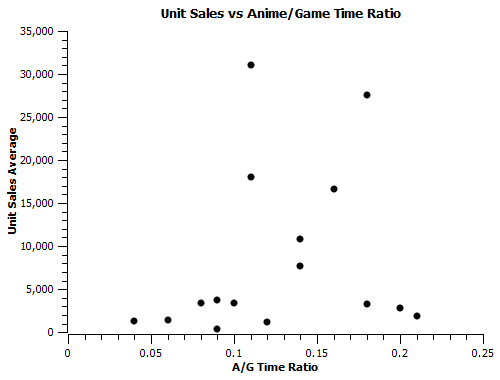
First, though, it would help to know; what is a typical ratio of anime runtime to game playtime? Between gamefaqs (user-submitted averages) and vndb (ranges of playtimes), I was able to put together a fairly complete list of approximate hours taken to complete the 16 VN and console games adapted into anime in 2011 and 2012 (chosen because I’ve already done some research on those and had them available). I then compared that value for each show to the number of hours (assuming ~20 minutes per episode) allotted to its anime adaptation. For these 16 games, there was an average of 0.13±0.05 minutes of anime for every minute of game playtime, and most series fell within that range (the lowest ratio was Hoshizora e Kakaru Hashi’s 0.04, the highest was Hiiro no Kakera’s 0.21). Turns out, there was a pretty interesting (though it is perhaps just a product of small sample size) relation which fell out of plotting the ratios against another well-known quantity – disk sales averages:

A_G-disksSpecifically, it seems that, while there is a lot of variance for any given range of A/G time ratio, there are no 10k+ hits with a ratio lower than 0.1. The sample is small enough that I don’t want to say too much about this at the moment, but if this holds up in other years, it could be a definite point in favor of the argument that game adaptations that face extremely uphill battle in squeezing in content are more likely to fail (or less likely to hit) than those with a little more leeway in terms of allotted airtime.

Fun With Numbers: Berserk’s Third Movie Offers an Upper Bound on US Amazon Sales Projections

I’m officially done tracking US release data for the month of April, and the full data is here, if you care to check. I’m not posting a full summary; a lot of things got released, and I’m at the point where each month of data isn’t going to revolutionize my results. But there was one neat null result I got out of this month. The BD for Berserk’s third movie (Golden Age: Advent) put up the best release week of any release I’ve tracked to date, spending the majority of the days between April 15 and April 20 in triple digit rankings. Despite this performance, and a healthy amount of preorder ranking, it failed to crack the top 20 on the US BD charts (preorders are counted in first-week totals).

I’ve been collecting older BD charts via the Numbers for two months now (they’re about 2-3 months delayed from the present time), and those (from January and February in particular), suggest that a release needs to move between 10,000 and 20,000 BD units to crack the number 20 slot in any given week. Therefore, any amazon-rank fit I use to try and convert the numbers into approximate sales figures should be able to take that Berserk data from March 25 through April 20 and come out with a sales figure below at least 20,000, possibly below 10,000 (I’ll have more exact figures in a few months when the Numbers catches up to that week). That’s not a super-tight constraint, but it’ll help me clean out some of the more egregious overestimates in trying to fit the data (this may or may not disqualify the fit I used on the March data, which projects the movie at just a hair under 16,000 copies).

Midseason Update: This Season in Kare Kano Quotes

Every quarter, I take the anime season as excuse to go watch and quote-mine one of my old favorite shows. This time, the one on the chopping block is the show that is my favorite Hideaki Anno show and the show it took me the longest to watch to the end (I acquired the first 3 DVDs over the course of 2007-2008, then didn’t get my hands on the last 2 until 2011). The show has a really interesting, introspective romance plot backed up by some fantastic backgrounds, and I picked it this time around because this Spring 2014 season features plenty of both being played for great effect.

KareKano

 Helps that it was wicked fun to rewatch

Continue reading

Fun With Numbers: May 2014 US Amazon Data (Initial Numbers)

This is just an infodump post for the May series I’ll be tracking, compiled via amazon’s upcoming anime releases list. Not much beyond the initial numbers here. The April summary post will be up in a week or so (though it won’t have updated charts – I want to just keep collecting data for the next few months before I try identifying trends again).

Continue reading

Fun With Numbers: Google Traffic Predicting the Fall 2013 Disk Over/Unders

Continuing on my series of disk-sales predictor checks, I’m checking whether google search traffic for Fall 2013 series’ Japanese and Romanized titles did a decent job with their eventual v1 disk sales with a simple over/under accuracy check for the top 5, 10, and 15 series each month. Results are shown below (accuracies better than the null hypothesis in green):

google-comp

Google traffic seems to be be a fairly strong indicator of disk sales, especially in December, where the top-10 check achieved the highest accuracy of any metric to date. That’s a very positive sign for the metric; I was actually expecting it to be more indicative of casual manga/LN-sales interest. We’ll see how it ultimately does there when I get the sales bump data together in a couple weeks.

Fun With Numbers: Normalized Google Traffic for Fall 2013 Anime

A big part of my goal is to take a look at existing numbers and see what can be gleaned from them, but that doesn’t mean I can’t take a stab at collecting new metrics. This post is just a summary of one rarely-used metric I’m curious in gauging the efficacy of, normalized google traffic, for anime aired in the Fall 2013 season.

Why check google traffic? It’s not complicated; most people with access to anime have access to the internet. And most people with access to the internet end up using search engines a lot. So you can (theoretically) get a good first-order approximation of how much relative interest an anime has generated by checking its search traffic volume against some other predetermined total (the volume of the term “Fall 2013 Anime” for the month of October is used here). By using volume for both the original Japanese and Romanized titles, it’s possible to parse the traffic in Japan versus the rest of the world. Show data is found on this doc, and listed after the break for the 38 Fall 2013 shows whose v1 data I’ve been using in predictive tests.

Continue reading