Fun With Numbers: Directors With Blockbuster Chops (Part 1: 3 or More Shows)

Unless you’re Urobouchi Gen,* if your name headlines the trailer of a given series, odds are you’re its director. Director credits are the first non-voice actor bit of information given on staff pages of ann, anidb, and mal show pages. And that’s how it should be; as important as good writing can be, directors have the desk the buck stops at when it comes to power and responsibility to make decisions in show production, often holding full or partial authority to rewrite an episode script. Ano Hana was written as part slapstick/erotic comedy before director Tatsuyuki Nagai got his hands on the script. Beyond that, directors supervise the visual component of anime, making sure a series’ art says what it’s supposed to and flows from shot to shot.

A lot of complex factors go into an anime being either a success, hit, or failure, but it’s really hard for an untalented creator to accidentally produce a hit more than once. And while hit tv anime aren’t the only achievement that deserves recognition (JMAF grand prizes and Oscars would be two others), they are one of the bigger ones; excluding sequel seasons, less than 100 people have managed to notch this achievement in the 50+ years since Astro Boy first aired.

This is the very short list of directors who have headed at least 3 separate hit franchises, with some supplementary information. A similar post on those who have made 2 shows will be up sometime in the near future.

This list was compiled from something’s list of 10k+ shows, with supplementary resume data pulled from ann and anidb. While I am making heavy use of these databases, I don’t trust them to be 100% complete: Seiji Kishi’s pages show an 8-year gap between his first credits and his first series directed in which he does (supposedly) nothing. Not only that, but anidb and ann disagree on whether his first work was as an in-betweener on Ruin Explorers or on Eiga Nintama Rantarou (anidb lists the former, ann the latter). Tatsuyuki Nagai’s first credit is as an episode director, a position not typically awarded to newbies. More likely their full histories aren’t chronicled here, though that only applies to secondary roles played in production. It’s an important thing to be aware of.

An Important Note About The Classification: I only included non-sequel anime when looking for directors. This means nothing with some manifestation of a 2 in the title. Ditto for Gundam or Macross franchise entries after the original. My rationale is that it’s a lot harder to make a prime-time anime from scratch, even with popular source material, than it is to continue living in a house you or someone else built. I count A Certain Scientific Railgun and Mononoke as spinoffs rather than sequels, as the series they spun off of are considerably less well-established franchises.

Continue reading

Fun With Numbers: Pay Dirt in Blu-Ray/Amazon Monitoring

A couple days ago, I was refreshing home media magazine’s site like a madman in hopes of getting a rough estimate of Attack on Titan’s placing. The result, a top 20 BD chart with no anime in it, was a disappointment to me despite my hedged bets about how shaky my amazon fit model was. Turns out, this might not be so much an indictment of the model as of the usability of the HM magazine/VideoScan First Alert charts they use.

Because it turns out that, contrary to their April 6 BD chart, a certain classic series sneaked on to the The Numbers’ top 20 BD disk chart, giving me my first solid high-end number in ever:

BDchart-DBZs3

For reference, using the amazon fit formula on the existing data (daily sales=300,000/daily amazon rank) and counting preorders of the series, the model estimates the first week sales of DBZ’s season 3 BD rerelease would be about 6034 copies. That’s a bit lower than the actual result, likely because of a possible storefront effect for popular titles that reader fredofirish brought to my attention. Still, that’s only off by about 20% of the actual value; not bad at all for a rough guess. Given this result for a series that peaked in the upper 300s, I am 99% sure we’ll be seeing the AoT release that made double digits on these same charts in a few months, and we might even see Berserk III on there in two weeks.*

Also, YEEEEEEAAAAAAAAHHHHHHHH!!!!

*It peaked at a similar place to where the DBZ release did, though this week’s threshold was also fairly generous.

Fun With Numbers: CD Singles’ Loose Disk Average Relation

As it does with many others, anime is somewhat intertwined with the music industry. One of the biggest production outfits in the business, Aniplex, is a subsidiary of Sony Music Japan, whose music labels typically get first dibs at on involvement in a show that Aniplex has greenlit. Even outside of shows with blatant music themes tied into vocal superstars, the relation between a show and its associated singers is an interesting topic for study. Previously, I took a look at how a series’ OP/ED CD sales corresponded to the presence of a visible boost in print source material. This time, I’m going to take a look at the same CD sales data, but compared with disk sales.

Specifically, I’m looking at the week one sales of a series’ first opening single and first ending single, via the myanimelist news board.* That is, when they’re both on sale as individual CDs and not bundled with disks like the openings to the second season of Monogatari were (in such cases, I only counted the one towards the average). If a CD didn’t chart, I put it down as a dash and counted it as a 0. If a CD contained both the opening and ending theme, I put that total as the average. Data for disk averages for each show in 2013 is taken from someanithing. It was pulled a couple weeks ago, and it may be slightly out of date, but should be fairly close to the current values. The analysis can be found here, and is summarized below. Note that I decided to exclude series with episode lengths under 20 minutes from the final sample.

Continue reading

Fun With Numbers: May US Amazon Data and Attack on Titan’s Nonzero Shot at the US BD Charts

Amazon data for the series I was tracking in May is here. It’s largely unremarkable; only 4 series spent prolonged periods of time ranking in the quadruple digits, and 3 (Yugioh, Fairy Tail, and DBZ) were long runners.

More interestingly, Attack on Titan started soliciting this week. If my calculations are correct, it has a very real chance of snagging a spot on the BD charts in the US, becoming the first anime release to do so since I began tracking series this February.

Note: While what follows is based on data I have gathered, it is largely speculative and makes a number of assumptions, among them that amazon performance is indicative of the BD/disk market in the US and that anime does not perform significantly differently from other types of titles in similar places in these rankings. These may well be way, way off, so take it with a heavy dose of skepticism.

Continue reading

Fun With Numbers: Print Sales Bumps and Poking at the Demand Curve

It’s fairly common for manga or light novels getting an anime adaptation to receive some sort of boost in sales after the anime airs. However, both the presence or size of those bumps varies widely. These bumps represent an interesting opportunity for study, since they represent (potentially) an alternative indicator of both the financial impact of anime, as well as a look at the broader-scale demand curve for franchise-related goods. Not everybody can or will easily pay 30,000 yen for a full special-feature-laden set of disks, but such casual fans could still have a big impact on a series if the manga is within their price range.

The real fascinating part of this, though, is that casual fans need not support at all. While one almost certainly has to watch a show to be willing to buy the disks or even the manga, the reverse need not apply. The fact that the relation between disk averages and print boosts is so fragmentary implies a potentially similar disconnect between print bumps and total interest generated by a show.

In theory, sales should be better represented by casual indicators of popularity as costs get lower. In practice, the statistics are pretty garbled, though they do offer a hint as to which sorts of series may end up with bumps at the end of the day. To attempt to better understand the junk described above, I broke down 4 categories potentially indicating no-cost and low-cost popularity, and compared their ratings with the print-bump successes of series which got anime adaptations in Summer and Fall of 2013. Note that while I originally used Torne rankings in the earlier analyses, I discarded the data because of how incomplete they were.

For the purposes of this article, a “significant boost” is one where a series experiences a 20% jump in sales or charts for the first time after the anime. All figures are for a volume’s first 2 weeks of sales, calculated with the average of the 2 most immediate before and after volumes, if 2 volumes of data are available in each case. Be aware that this is not a comprehensive measure of which series got boosts, just one intended to at least catch the biggest ones. 1/3 of all series got such a visible bump, meaning the null-hypothesis accuracy rate these indicators need to beat is 66.6%~67%.

In addition to the previous top 5/10/15 tests used for v1 disk sales, I’ve also included histograms of how successful series were scattered across the indicator. Ideally, they would all be 60th percentile or better, but reality isn’t quite that nice.

Continue reading

Fun With Numbers: June 2014 US Amazon Data (Initial Numbers)

Here’s the usual infodump post of initial numbers for the series whose June amazon ranks I’ll be tracking, gathered from this list of upcoming releases. As before, May data is still being collected and will be posted when that’s done in about a week.

Continue reading

Fun With Numbers: Anime as Light Novel Advertisments in 2013

While light novels work a bit differently from manga in several key ways (stronger second-week showings, lower thresholds, etc.), they similarly often see big boosts after and presumably due to from anime adaptations. I collected the light novel sales history of the series to get anime adaptations in 2013 on this doc, and plotted them on the charts below, to illustrate which series did and didn’t get visible boosts.

This post doesn’t cover series with no post-airing releases (Maoyu, Uchoten Kazoku) or no pre-airing releases (Free/High Speed).

Continue reading

Fun With Numbers: Anime as Manga Advertisments in 2013

The commercial impact of anime goes well beyond its disk sales. Manga may sell to more people, but anime is extremely visible, airing on TV (albeit often late at night) and propagating around the internet at a very rapid pace. This visibility very often can lead to an increased strength of the franchise in general, propping up sales of print material, figures, and any various other related goods. Sometimes, anyway. 2013 was no exception, and saw a number of manga adaptations have anywhere from minimal to explosive effects on the sales of their source material.

I collected the manga sales history, including thresholds for series which charted sporadically, on this doc, and plotted it below. Note that these sales are not total, but the total number reported in a roughly fixed time period. Comparing sales tail length is a whole other issue, and I’m trying as much as possible to compare like figures.

One important difference from similar breakdowns of 2011/2012 series is that here I’ve opted to use the total sales from a series’ first 2 weeks of release (the highest reported total in that time interval), to attempt to minimize the effects of a bad split in creating artificial variations. It’s still an issue either way, but the difference between 9 and 14 days is a lot less than the difference between 2 and 7 days.

Two important series-specific notes prior to the plots. First, Maoyu is plotted here, in the manga section, because the manga charts more consistently than the light novel did and, more importantly, has available data from both before and after the anime aired (the LN ended just prior to 2013). Second, I can’t parse impact for series that don’t have at least one volume which released after the anime began to air. I thus will not be covering Servant x Service here, though there is data available. I will cover it in an addendum post come September when volume 4 has been out for 2 weeks.

Continue reading

Fun With Numbers: (Admittedly Arbitrary) Qualifications for Significant Print Sales Boosts

I’m about to dive headfirst into the manga/LN print data I’ve gathered and check how much the series that got adaptations benefited from them. It’ll take a week or so, but when I’m done, I’ll have charts like the 20112012 ones and a wealth of organized first-two-weeks data to cross-reference with the casual-indicators checks I’ve been doing, and I should be able to more or less finish that project. Before I do that, though, I just want to outline some guidelines I’ll be using for said project before actually gathering the 2013 print data.

One of the key problems I bumped into early on was how to classify boosts as big/small/significant/what have you. It’s a complicated issue that in practice goes far beyond the Oricon charts, but for the purposes of this project, I’m going to focus primarily on chart-visible boosts. These get split into two categories; one, the type where a series makes the charts for the first time post anime, and two, the type where a series sees a sharp uptick in post-release sales. After looking into the previous year’s record, I decided on different criteria for each.

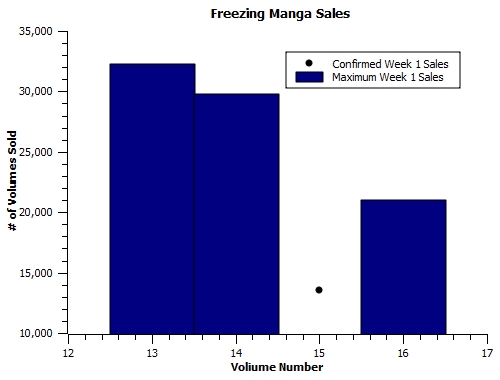
I’m going to consider first-time charting significant if a previous volume was released under a threshold that would not have prevented the first-time-on-charts total from charting. In other words, most series charting for the first time will make this cut, but it’ll disqualify series like Freezing that charted under these ridiculously friendly circumstances:

Freezing-manga2I’ll consider boosts for series consistently on the charts significant if a series sees a 20% uptick in first two weeks of release sales from the immediate pre-anime period to the immediate post-anime period (averaged over 2 volumes, if possible). Even if the effects of anime adaptations extend well beyond this limited scope, I hope this will at least be indicative of which series made the very best of their source material boosts.

Also, I’m going to avoid analyzing series that lack post-anime releases (Servant x Service) or pre-anime releases (High Speed). For obvious reasons, both before and after data are necessary to identify a boost.

Fun With Numbers: Myanimelist Stats’ Correspondence with the Summer 2013 Disk Over/Unders

Quick recap: I’m taking a look at various no-cost indicators of popularity for anime and their related goods. First, I’m checking how well they correspond to disk sales by checking whether different applications of that statistic beat the null “every v1 will sell less than 4000 disks” accuracy criterion for a given season (66% for Fall, 59% for Summer). Later I’ll check how well these indicators corresponded to boosts in manga/LN source popularity (for works that were originally LN/manga), to contrast their predictive abilities at both high-cost and low-cost levels of interest.

This entry covers the myanimelist rankings and popularity for the 34 Summer 2013 shows I’ve been looking at, with the title tweaked to reflect that these are the series rankings from several months after the series have ended. It shouldn’t be a huge factor; positions don’t shift radically that often, especially after a series is done airing (more research on that forthcoming). The data I gathered can be found here, and the results are shown below.

Summer2013-mal-compCompared to Fall, Summer showed a relatively weak performance by the mal metrics. The popularity component still does alright, but the the rankings consistently underperform the accuracy of the null hypothesis. This is more in line with what I would have expected going in; there’s a lot of evidence to suggest that casual audiences aren’t that different inside and outside of Japan, but there’s a very relevant degree of separation between casual audiences and disk-buying ones. Too, a series’ aggregate score being less important to sales is unsurprising, as the series profile of “publicly lambasted but successfully appealing to its target audience” is exceedingly common in any medium.*

*It’s a principle potentially less applicable with nico rankings because they represent the subset of people watching via nico streams, which can be a qualitatively different audience from one that DVRs episodes and/or stream through other services.