Fun With Numbers: Anime as Manga Advertisments in 2012 (and their respective myanimelist ranks)

Update 2 (July 15, 2014): New, more accurate data is here.

Update (Jul 1, 2014): This post doesn’t measure releases in 2-week totals, which turns out to be a huge deal in many, many cases. I’m currently working on an updated version of both this and the 2011 data. Just be aware of that before citing the data from here regarding any one show.

By all rights, a 30-series sample like the one I had for 2011 was enough to get most of the relevant information regarding how anime boosted manga sales. However, during that analysis, I bumped into an incidental correlation, myanimelist ranking versus gain in manga sales, that was far too juicy to ignore. If that correlation is real, it points to a very tangible link between the Japanese mainstream community (who have enough disposable income for manga but not for anime) and the English-speaking online community (who generally pay a comparable pittance, if anything, for the anime they watch). But I couldn’t be sure from just the 2011 data, since that was the sample that gave rise to the theory. So I did what any good researcher would do, and pulled another year worth of data to see how things would match up. The results can be found on this spreadsheet, and are sorted in order of descending myanimelist rank below.


Continue reading

Fun With Numbers: Thermae Romae, Curious Outlier

One of the interesting tidbits that fell out of my research on manga that got anime in 2011 was the surprising coincidence of high (1500th or better) myanimelist rankings and increased manga sales. At least, it was intriguing enough that I decided to delve into it further, pulling sales figures for the 20 manga which both got anime and charted on the Oricon rankings in 2012. The full analysis is coming, but, short version, there’s a 90-plus percent that that correlation is a very real thing, indicating a strong link between the opinions of myanimelist users and the Japanese manga-buying public, to the extent that I might even be able to plug it in to my sequel probability equation and get the “can’t predict loss-leader effects” monkey partially off the sequel probability equation’s back.

All of which makes Thermae Romae, which presided over a 100k+ increase in week one sales of its manga while posting a piddling rank of 2248th on myanimelist, a case worth a closer look.* Is the jump in average week-one sales from 222,000 volumes for 3 and 4 to 323,000 volumes for 5 and 6 indicative of the effects of the anime, which began and ended between the releases of 4 and 5? Continue reading

Fun With Numbers: How Much Does Promoting Manga Help Anime?

Ever since Inu x Boku SS first drew my attention to the subject in June of this year, I’ve been quite interested in the concept of anime in the context of its broader commercial impact. It’s not exactly counter-intuitive to point out that anime doesn’t get made in a vacuum where disk sales, important as they are, are the only thing that determine the success or failure of a project. There are many factors that play into that equation; licensing cash, character goods sales, TV ratings, etc.

But manga sales are particularly interesting for two reasons. First, we can track them fairly easily; animenewsnetwork keeps English-language versions of the weekly Oricon rankings of manga that date back to 2008, so there’s a lot of baseline data that we can compare with newer series. So when Blue Exorcist did Blue Exorcist things…

FWN-BlueEx-1

…it’s pretty obvious where the cause lies. Second, because the increase in sales per volume can potentially be really high (see above chart), it’s sometimes worth it for manga publishers to take a gamble and partially fund an anime adaptation. While such funding isn’t going to pay for most anime by itself, readers of this blog will be aware of the tangible influence of marginal increases in financial stability.

What follows is an analysis of how manga to get an anime adaptation in 2011 fared overall at the marketplace, with a look at when and why publishers chipping in for an adaptation ala Shonen Sunday in 2013 is a good business move in theory (while still hinging, as everything ultimately does, on competent execution).

Continue reading

noitminA Has Nothing on the Nihon TV Tuesday 24:50 Slot

One of the fruits of digging into the adaptations of manga produced in 2011 has been a treasure trove of TV anime ratings data. Which, in turn, holds heaping helpings of unrelated but utterly fascinating information.

My favorite tidbit so far? Timeslots that get designated to run a certain kind of show are much more prevalent than I, at least, had thought. People may deify noitaminA for its stellar pre-Fractale record, but if you want to talk anime-focused timeslots with godly 7-year runs, there’s at least one very prominent contender. The Nihon TV 24:50 timeslot (plus/minus 10 minutes, depending on the quarter) hosted the following shows from 2000 to 2011:

Show Title (Airdates) (Ratings for First Episode)

Hidamari no Ki (2000-04) (3.2)
Hajime no Ippo (2000-10) (4.8)
Tenchi Muyo GXP (2002-04) (4.3)
Hanada Shounen-shi (2002-10) (3.1)
Air Master (2003-04) (4.4)
Captain Harlock [TV Airing of Endless Odyssey OVA] (2003-10) (3.4)
Gokusen (2004-01) (3.8)
Monster (2004-04) (3.2)
Akagi (2005-10) (2.4)
Ouran High School Host Club (2006-04) (2.1)
Death Note (2006-10) (3.4)
Buzzer Beater (2007-07) (2.5)
Kaiji (2007-10) (3.2)
Real Drive (2008-04) (2.0)
One Outs (2008-10) (2.5)
Souten Kouro (2009-04) (2.6)
Kimi ni Todoke (2009-10) (2.8)
Rainbow (2010-04) (2.2)
Kimi ni Todoke [cut reair] (2010-10) (2.1)
Kimi ni Todoke Season 2 (2011-01) (2.1)
Kaiji Season 2 (2011-04) (2.3)
Chihayafuru (2011-10) (2.4)

Note in particular the period from 2004 to 2011. That’s some serious all-around ass-kicking, a double whammy of ratings that aren’t bad (especially for 12:50 in the morning) and maximal critic-pleasing potential. By all accounts, this timeslot is currently plugged; Chihayafuru’s second season aired at 25:59, and I can’t find anything currently airing in it. But still, phenomenal run. I guess I’m adding timeslots to the list of industry-related things that really ought to be looked into.

Edit: Corrected the title to reflect the actual day of the timeslot.

Midseason Update: This Fall in Kaiji Quotes

In Fall of 2007, I was very much a beginner at anime. I’d explored the discount stores in my neighborhood and encountered some very interesting, engaging titles, but I wasn’t any kind of plugged in to what stuff was current. One series changed all that, basically on its own.* Gambling Apocalypse Kaiji was the complete package in so many ways; tense, human drama, a rich cast that skirted the line from likeable to detestably inhuman, tight direction, idiomatic yet pithy dialogue, and the best narrator in anime bar none.

Midseason-Fall-4

Those last 2 attributes also make the show handy for an alternate purpose; rampant quotation abuse! There’s a Kaiji quote for everything, and the Fall 2013 anime season is no exception. In celebration of the show’s free availability on crunchyroll, let’s break it down.

Continue reading

Fun With Numbers: Anime As Manga Advertisments in 2011 (Part 2: The Upper-Limit Baselines)

Update 2 (July 15, 2014): New, more accurate data is here.

Update (Jul 1, 2014): This post doesn’t measure releases in 2-week totals, which turns out to be a huge deal in many, many cases. I’m currently working on an updated version of both this and the other 2011-2012 manga boost posts. Just be aware of that before citing the data from here regarding any one show.

Way, way back, I published an article looking at how anime adaptations produced in early 2012 affected the sales of their source manga. It was interesting data to take a look at, and it was interesting to see which anime really boosted the manga sales. Long story short, there are cases where a manga really jumps from mid-tier to franchise level (Space Brothers, Kuroko’s Basketball, Inu x Boku SS) soon after the anime airs, and cases where the anime doesn’t have much visible effect.

Also way back, I started pulling sales records for manga that had an anime adaptation air in 2011, to get a better idea of how the two media are interrelated. This post contains the second half of that data, specifically the data for which I have maximum constraints for series before they aired, and at least one solid instance of making the Oricon charts afterwards. These aren’t quite the tier of hits in the first part of the data, but they’re more marginal, which makes the charts pretty interesting by themselves.

Continue reading

Fun With Numbers: The Anime Sequel Probability Equation (Alpha)

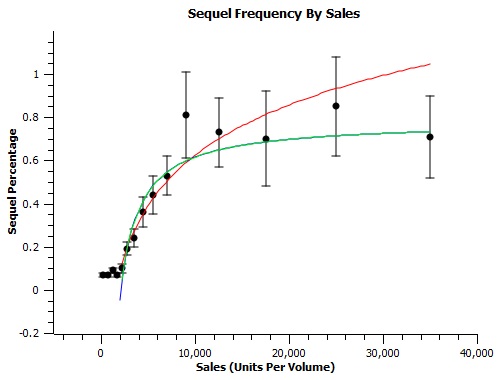
Ever wonder what anime get sequels and what don’t? The simple answer to this fairly simple question is “sales, plus a few mitigating lesser factors”. We know this, beyond the obvious intuition, because over the years, we see those with robust sales totals get continued much more often than those with lackluster ones:

FWN-Sequel-B-SalesA more interesting question is perhaps this; which anime this year have the best chances of getting continued? After some delving into the subject, I can finally answer this question to a respectable degree of confidence. Based on data from 615 shows airing from from 2005-2012, the first season of an anime which sells x units per volume has P odds of getting a sequel, meaning either a second season or a movie.

P(x, t, L)=.01+θ(x-2250)*(.7-1650/(x+L*750))*e^(-((t-1)*θ(t-1))/.7)

Where t is the time in years passed since the first season aired, and L=1 corresponds to the series having been licensed. θ is the step function, 0 when the number inside the brackets is less than 0, and 1 when the number inside is greater than 0.

Continue reading

Fun With Numbers: Perspective on Crunchyroll Manga’s Starting Lineup

I’ve had a bunch of stuff I’d like to write about on the back burner for a while now; Yozakura Quartet’s new OAD-bundled volume selling about 17,000 copies when the maximum cost of the OVA would have been covered by 9000, a return to the issue of sales boosts that manga get from anime, and the slow-but-ongoing attempt to accurately set odds for the sequel of any given anime series. All of those are important questions, and I’ll address them in due time.

But right now, manga giant Kodansha and popular legal stream platform crunchyroll rolled out a bombshell: Crunchyroll Manga. Current to Japan digital releases of 12 manga (headlined by Fairy Tail and Attack on Titan, ones I pegged months ago as potential headliners for a Kodansha USA service) that are fairly big in the U.S, for 5 bucks a month.* This isn’t as big of a deal as some of the other things I’ve observed, but it certainly has the potential to make a big impact. I don’t want to be premature, but the combination of the CR brand and the solid rollout slate (similar to how CR packaged big names in anime when they first decided to go legal) has me optimistic about the prospects of the service.

CRmanga

This is very much a first-response column, looking at the statistical profiles of the rollout and comparing it to Jmanga and Weekly Shonen Jump Alpha, two other big names in digital manga.** How does this compare with other digital rollouts?

Continue reading

Fun With Numbers: Explaining Why Unpopular Anime Get Sequels

If there’s an inverse situation to not seeing a sequel to something you liked that you know was really popular, it’s getting a sequel when you in no way expected one. Disc sales are a pretty good indicator of when something is commercially viable enough to get a second season, but they aren’t the only factor playing in. There are a couple of consistent ways that anime with non-profitable sales wind up with more than one season, and that’s what I’m looking at today. Examination of the ones that did sequel reveals a rather unsurprisingly grim prognosis for fans of old, poorly-selling shows hoping that they’ll get more.

Continue reading

Fun With Numbers: Explaining Why Popular Anime Don’t Get Sequels

There are few things more frustrating than loving an anime that has room to grow as a story, but never gets beyond one season of material. It’s arguably even more of an irritance when you know the second season would easily pay for itself. Fortunately, it’s very rare for popular anime to not get sequels (happens only about 20% of the time), and there are ways to predict which ones those will be. I like to think knowing softens the heartbreak.

Continue reading